


A metal centrifugal pump handling hydrochloric acid, sodium hypochlorite, or another corrosive solution may appear satisfactory at first and still develop material loss, pitting, or leakage over time if its wetted materials are not compatible with the process fluid. This is one reason chemical, textile, electroplating, and effluent-treatment plants may consider polypropylene centrifugal pumps for corrosive transfer duty.
Polypropylene (PP) is a thermoplastic that does not rust like ferrous metal and offers strong resistance to many aqueous acids, alkalis, and salt solutions. Its suitability is not universal, however. Chemical identity, concentration, temperature, pressure, exposure time, PP grade, and the compatibility of seals, elastomers, shaft components, and other wetted parts all matter.
This guide explains how PP centrifugal pumps resist common corrosion mechanisms, where they perform well, where their limitations matter, and which engineering factors should be checked before selecting a pump.
Key Takeaways
- Corrosion Resistance Depends on Compatibility: PP does not rust like ferrous metal, but the exact chemical, concentration, temperature, and construction must still be checked.
- PP Suits Many Corrosive Liquids: Many aqueous acids, alkalis, brines, and treatment chemicals can be compatible with PP under suitable operating conditions.
- Do Not Use a Generic Temperature Limit: The allowable temperature depends on the PP grade, pump construction, pressure, and fluid. Confirm the approved limit for the exact pump.
- Thermoplastics Are Lightweight: PP construction can reduce equipment weight, but piping loads and support design must still follow the manufacturer’s installation requirements.
- Seal Selection Is a System Decision: Fluid hazard, temperature, pressure, vapor behavior, lubricity, solids, and emissions requirements all influence sealing choice.
- Common Uses Are Application-Specific: Chemical processing, textile dyeing, electroplating, effluent treatment, and compatible agro-chemical duties are common areas of use.
- Hydraulics Still Matter: Flow, total dynamic head, NPSH margin, specific gravity, viscosity, solids, and duty cycle determine whether the selected pump can operate reliably.
- Inspect the Complete Pump System: UV exposure, mechanical loading, incompatible cleaning chemicals, poor suction conditions, and incorrect fastener practices can shorten service life.
What Makes a Pump “Corrosion-Resistant”?
Corrosion resistance comes primarily from the compatibility of the materials that contact the process liquid. In metallic pumps, an unsuitable fluid can cause pitting, general corrosion, crevice attack, or other forms of material degradation. A coating alone does not make every pump suitable for every corrosive chemical.
A polypropylene pump takes a different approach by using chemically resistant polymer components in key wetted areas. PP does not undergo rusting in the way carbon steel or cast iron does, but “corrosion-resistant” should never be interpreted as “chemically resistant to everything.” The complete wetted material set must be compatible with the actual duty.
If you are evaluating corrosive fluid transfer more broadly, MRP Pumps’ chemical transfer pump selection guide explains how material choice fits into the wider pump-selection process.
What Is a Polypropylene Centrifugal Pump?
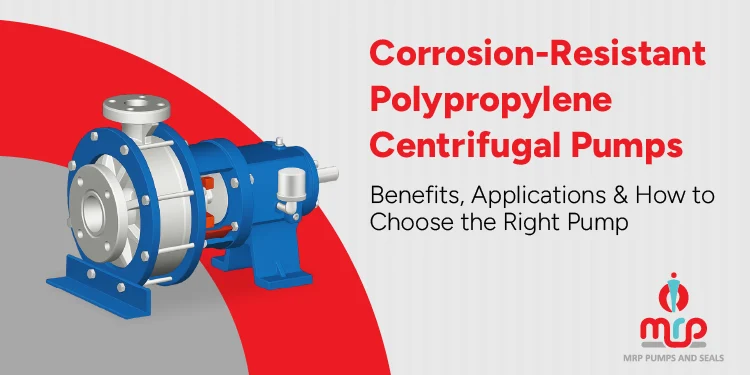
A polypropylene centrifugal pump is a centrifugal pump that uses polypropylene or other compatible non-metallic materials in selected wetted components such as the casing and impeller. The exact shaft, sleeve, seal, elastomer, and internal construction varies by pump design and fluid compatibility.
The hydraulic principle is the same as a conventional centrifugal process pump: the rotating impeller adds energy to the liquid and develops flow and head. The important difference for corrosive duty is the material system exposed to the process fluid.
PP pumps are therefore considered when chemical compatibility is a dominant selection factor. They are not automatically the best choice for abrasive slurries, high mechanical loads, high pressure, elevated temperature, or fluids that are incompatible with the selected polymer and sealing materials.
How Does Polypropylene Resist Corrosion?
Polypropylene is a non-metallic thermoplastic, so it does not participate in rusting or galvanic corrosion in the same way as ferrous metallic pump components. When PP is chemically compatible with the process liquid, this can reduce corrosion-related attack on the polymer casing and impeller.
That does not mean every component in the pump or piping system is immune to corrosion. Metallic shafts, sleeves, fasteners, seals, connected piping, or other wetted parts can still be affected if their materials are incompatible. Material selection should therefore be performed for the complete wetted path, not only the pump casing.
What Chemicals and Fluids Can a PP Centrifugal Pump Handle?
PP centrifugal pumps can be suitable for many corrosive aqueous liquids, but compatibility must be checked at the actual operating conditions. Typical duties may include:
- Compatible dilute mineral-acid solutions, subject to concentration and temperature
- Caustic soda and other compatible alkaline solutions
- Sodium hypochlorite and chlorine-based treatment chemicals within verified compatibility limits
- Brine and saline process water
- Compatible dye liquors and textile-finishing chemicals
- Compatible electroplating and pickling-bath solutions
Chemical compatibility depends on more than the chemical name. Concentration and temperature can materially change how a fluid interacts with PP, elastomers, seal faces, gaskets, and other wetted components. Organic solvents also require individual review because PP is not universally resistant to all solvents.
Before finalizing a pump for a new chemical duty, check a current compatibility chart for every wetted material and confirm the operating envelope with the pump manufacturer.
Not Sure Whether Polypropylene Is Compatible With Your Chemical?
Share your fluid type, concentration, temperature, and operating conditions with MRP Pumps to help determine whether a polypropylene pump is suitable for the duty.
Polypropylene vs. Stainless Steel Centrifugal Pump: Which Should You Choose?
| Factor | Polypropylene Pump | Stainless Steel Pump |
| Chemical resistance | Strong for many compatible acids, alkalis, and salts | Highly dependent on alloy grade and fluid chemistry |
| Temperature capability | Generally lower; confirm exact pump and material limit | Generally higher, depending on alloy and pump design |
| Pressure and mechanical strength | Generally lower than comparable metal construction | Generally higher |
| Weight | Lower material density and lighter construction | Heavier |
| UV and impact considerations | May require protection depending on PP grade and installation | Usually more tolerant mechanically |
| Relative cost | Can be economical for compatible corrosive duty | Varies widely by stainless grade and construction |
Neither material is universally better. For a compatible corrosive fluid within the approved temperature, pressure, and mechanical limits, PP can be a cost-effective alternative to stainless steel. Stainless steel may be more appropriate when temperature, pressure, structural strength, hygiene requirements, abrasion, or chemical compatibility favor a metallic alloy.
What Are the Limitations of Polypropylene Centrifugal Pumps?
PP pumps are not the right answer for every application. Common limitations include:
- Temperature limits: Polypropylene loses stiffness and dimensional stability as temperature rises, so the maximum allowable temperature must come from the exact pump and material specification.
- Lower pressure and mechanical strength: Thermoplastics generally tolerate lower pressure and structural loading than equivalent metallic constructions.
- UV exposure: Long-term sunlight can degrade non-UV-stabilized PP, so outdoor protection may be required.
- Abrasion limits: Chemical resistance does not equal abrasion resistance. Fluids containing significant abrasive solids may require a dedicated slurry-pump construction.
- Impact and piping loads: Thermoplastic casings and flanges can be damaged by impact, misaligned piping, or excessive nozzle loads.
Where Are Polypropylene Centrifugal Pumps Used?
PP centrifugal pumps, including MRP Pumps’ polypropylene centrifugal pump line, can be considered for corrosive transfer duties after confirming compatibility and operating limits.
| Application | Pump Requirement | Why PP May Fit |
| Chemical processing | Transfer compatible acids, alkalis, salts, and process chemicals | Polymer wetted components can reduce corrosion attack when chemically compatible |
| Textile dyeing and finishing | Move compatible dye liquors, bleach, and caustic solutions | Broad chemical resistance can suit many wet-process duties |
| Electroplating and surface treatment | Transfer compatible plating and pickling solutions | Non-metallic wetted components can reduce corrosion-product contamination |
| Effluent and wastewater treatment | Handle variable corrosive treatment streams | Can reduce reliance on metallic corrosion protection for compatible chemicals |
| Agro-chemical and fertilizer units | Transfer compatible fertilizer and treatment solutions | Useful where actual chemical formulation is verified against PP |
| Salt and brine handling | Transfer saline or chloride-rich liquids | PP avoids metallic chloride-corrosion mechanisms in the polymer wetted components |
How Do You Choose the Right Polypropylene Centrifugal Pump?
Selecting the right PP pump starts with chemical compatibility, then moves to the hydraulic, mechanical, and installation conditions that determine the duty point and component loading.
| Factor | Why It Matters | What to Check |
| Fluid chemistry and concentration | Determines whether PP and all other wetted materials are suitable | Compatibility at actual concentration |
| Operating temperature | Changes polymer strength and chemical resistance | Normal, maximum, and upset temperature |
| Flow and total dynamic head | Establish the hydraulic duty point | System curve against the pump curve |
| Specific gravity / density | Affects power requirement and component loading | Actual liquid density at operating temperature |
| Viscosity | Can alter pump performance and power demand | Operating viscosity, not only room-temperature value |
| NPSH | Insufficient suction margin can cause cavitation | Confirm NPSH available exceeds NPSH required with an appropriate margin |
| Solids and particle content | Can increase clogging and wear risk | Particle size, concentration, abrasiveness, and impeller suitability |
Need Help Matching the Pump to Your Duty Point?
MRP Pumps can review your flow, total dynamic head, chemical compatibility, temperature, and sealing requirements to help identify a suitable pump configuration.
Mechanical Seal or Glandless Design: Which Is Right for Chemical Duty?
Seal selection should be based on the complete service conditions, not only whether the fluid is classified as hazardous. Mechanical seals can be suitable for many chemical duties when the seal faces, elastomers, pressure, temperature, solids, lubricity, and vapor conditions are compatible with the application.
For leak-critical applications, a glandless or seal-less pump design may reduce or eliminate the dynamic shaft-seal leakage path, depending on the exact construction. The suitability of a seal-less design still depends on the fluid, process conditions, motor arrangement, materials, maintenance requirements, and manufacturer recommendations.
For hazardous, toxic, crystallizing, volatile, high-value, or environmentally sensitive liquids, involve the pump and seal manufacturer early so the entire containment strategy can be evaluated rather than choosing a seal type from a single rule of thumb.
Maintenance Checklist for Polypropylene Centrifugal Pumps
- Inspect the casing, impeller, flanges, and visible polymer surfaces for cracking, crazing, distortion, or chemical attack.
- Check the seal area for early signs of leakage and inspect elastomers and seal faces according to the maintenance plan.
- Do not introduce cleaning or flushing chemicals until their compatibility with every wetted material has been verified.
- Inspect fasteners and flange joints according to the manufacturer’s specified torque and retorque procedure. Excessive tightening can damage thermoplastic components.
- Protect outdoor equipment from prolonged UV exposure when the installed PP grade or enclosure requires it.
- Investigate unusual noise or vibration. Possible causes include cavitation, air ingress, misalignment, bearing problems, hydraulic instability, or impeller imbalance.
- Keep suction strainers, valves, and piping clear so the pump receives adequate NPSH available at the actual flow rate.
Why MRP Pumps
MRP Pumps manufactures polypropylene centrifugal pumps for corrosive and chemical-transfer applications and offers a broader range of centrifugal, specialty, vacuum, gear, vertical, progressive-cavity, and metering pump technologies. This allows the technical discussion to start with the application rather than forcing every fluid into one pump construction.
Based in the Kathwada industrial area of Ahmedabad and led by a founder with more than 15 years of pump-industry experience, MRP Pumps follows an application-first approach. Fluid properties, operating conditions, material compatibility, hydraulic duty, and sealing requirements should be reviewed before a final configuration is selected.
For technical consultation, spares, or a quotation, contact MRP Pumps at mrppumps@gmail.com or +91 98259 69278.
Conclusion
Choosing between polypropylene and metallic construction for corrosive-duty pumping requires a material-by-material review of the actual fluid, concentration, temperature, pressure, solids, and hydraulic conditions. PP can provide strong corrosion resistance for many compatible chemical services, but it is not a universal substitute for stainless steel, alloys, lined pumps, or dedicated slurry constructions.
If you are specifying a pump for acid, alkali, brine, or another corrosive transfer duty, MRP Pumps can help review the application and determine whether polypropylene is appropriate or whether another construction should be evaluated. Get in touch with our team to discuss your operating requirements.
Planning a Corrosive Chemical Transfer Application?
MRP Pumps can help evaluate whether polypropylene or another pump construction is more suitable for your fluid and operating conditions. Get Technical Assistance: mrppumps@gmail.com | +91 98259 69278
Frequently Asked Questions
1. Can a polypropylene pump handle sulfuric acid?
It depends on sulfuric acid concentration, temperature, and the complete wetted-material set. PP may be suitable for some sulfuric acid duties, but compatibility can change significantly as concentration and temperature increase. Always confirm the exact conditions against current material compatibility data before selection.
2. What is the maximum temperature for a polypropylene centrifugal pump?
There is no single temperature limit that should be applied to every PP centrifugal pump. The allowable temperature depends on PP grade, pump construction, pressure, chemical concentration, and other design factors. Use the approved limit for the exact pump and duty rather than a generic PP value.
3. Is a polypropylene pump suitable for outdoor installation?
It can be, but UV exposure must be considered. Non-UV-stabilized PP may degrade with prolonged sunlight, so the manufacturer’s material grade, enclosure, shading, and installation recommendations should be checked for outdoor service.
4. Can PP centrifugal pumps handle solids or slurries?
Do not assume solid handling capability from the PP material alone. Particle size, solids concentration, abrasiveness, impeller design, internal clearances, and passage size determine whether a pump can handle the liquid safely. Abrasive slurry duty often requires a dedicated slurry-pump design.
5. Should I choose a mechanical seal or a glandless design for hazardous chemicals?
The decision depends on the fluid hazard plus pressure, temperature, volatility, crystallization tendency, solids, lubricity, containment requirements, and maintenance strategy. Seal-less or glandless designs can reduce a dynamic shaft-seal leakage path in suitable constructions, while properly selected mechanical seals remain appropriate for many chemical duties.
6. How do I know if I need a PP pump instead of a stainless-steel pump?
Compare the exact chemical compatibility, temperature, pressure, mechanical strength, abrasion, hygiene, and lifecycle requirements of both constructions. PP can be a strong option for many compatible corrosive liquids, while stainless steel or another material may be better when the operating conditions exceed the polymer’s practical envelope.