


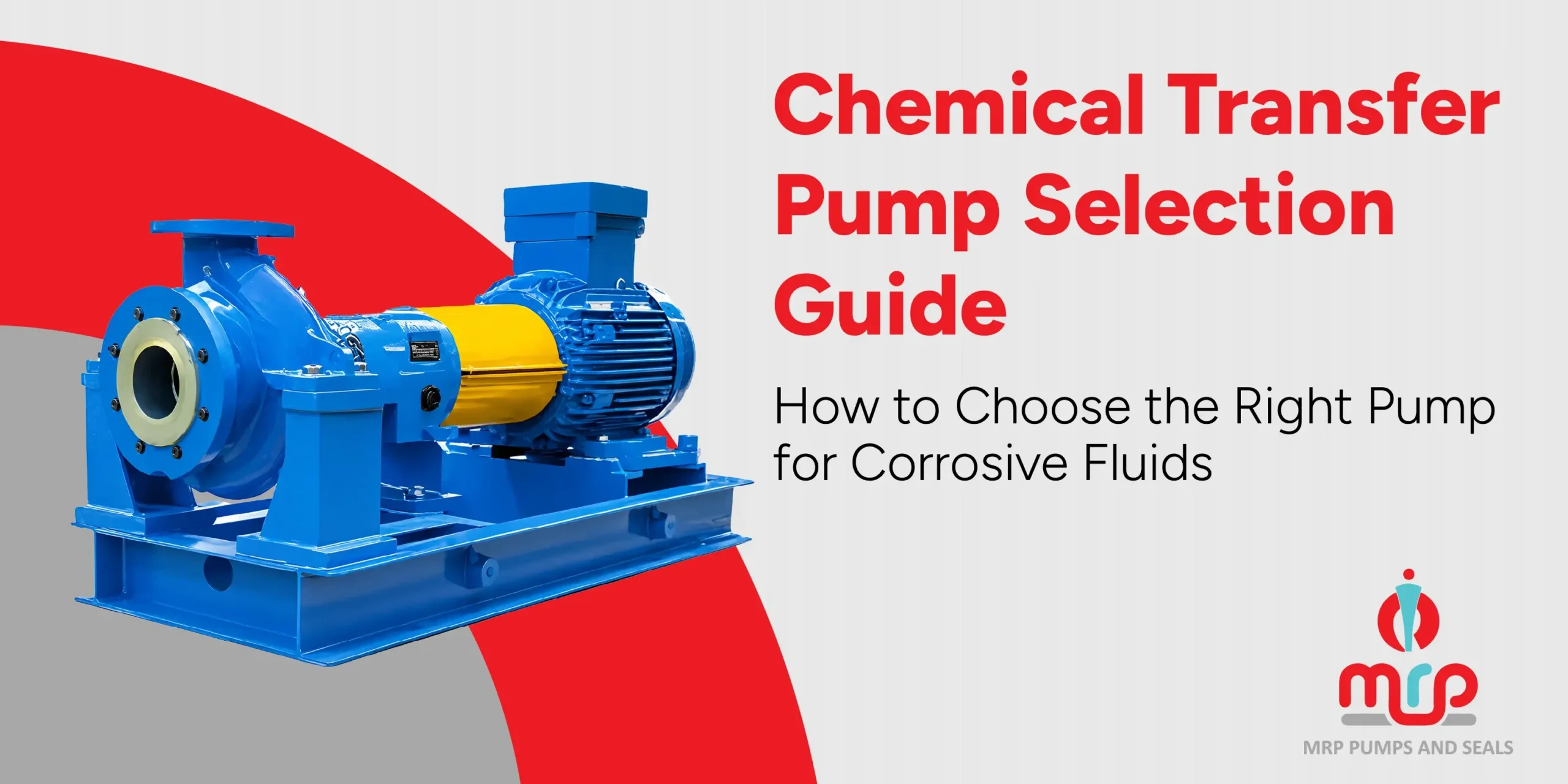
At MRP Pumps and Seals, we work with industrial buyers across chemical, petrochemical, and process industries who need pumps that survive aggressive, corrosive fluids without constant failure.
Choosing the wrong pump material or design often costs more in downtime and replacement than the pump itself.
This guide breaks down how to match pump type, materials, and sealing method to your specific fluid – so you can make that decision with confidence.
Key Takeaways
- Chemical compatibility, not flow rate, is the first filter when selecting a pump for corrosive fluids.
- Wetted parts (casing, impeller, seals) must match the fluid’s pH, concentration, and temperature profile.
- Polypropylene, PVDF, and PTFE-lined pumps handle most acids and alkalis; metal alloys suit specific high-temperature cases.
- Seal-less designs (magnetic drive, glandless) eliminate leak paths for hazardous or highly corrosive media.
- Routine inspection of seals, bearings, and wetted surfaces prevents 80%+ of avoidable pump failures in chemical plants.
- Standards like ISO 2858 and ATEX guidance matter for dimensional interchangeability and hazardous-area safety.
What Is a Chemical Transfer Pump?
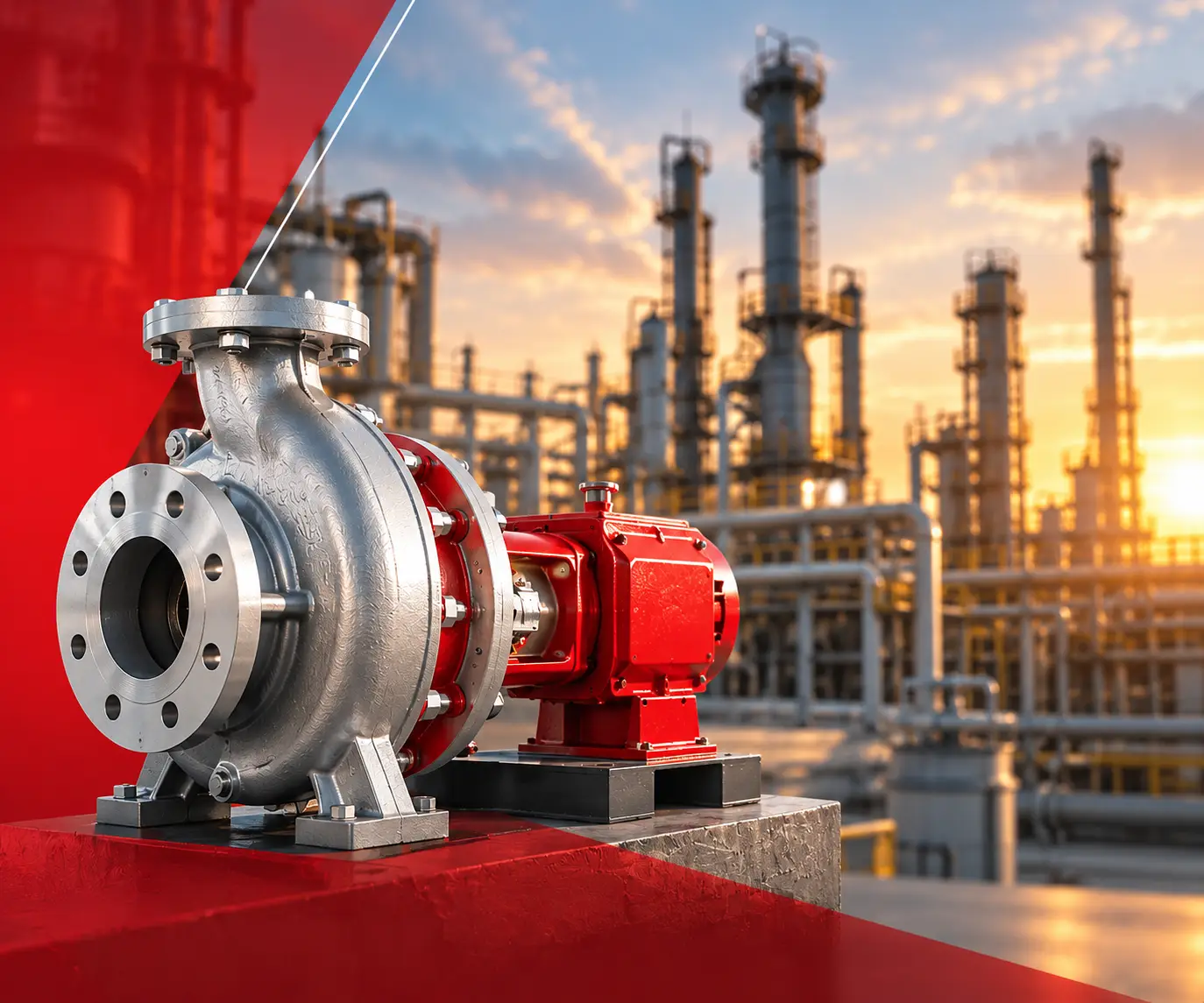
A chemical transfer pump moves corrosive, reactive, or hazardous liquids between tanks, reactors, or process lines. Unlike standard water pumps, it’s built with materials engineered to resist chemical attacks.
These pumps appear across chemical, petrochemical, pharmaceutical, textile, and fertilizer operations. Any facility handling acids, alkalis, solvents, or aggressive slurries relies on them daily.
Why Does Corrosion Resistance Matter Than Flow Rate?
Flow rate determines how fast a pump moves fluid. Corrosion resistance determines whether the pump survives long enough to do that job at all.
A pump with perfect hydraulic specs, but the wrong wet materials can fail within weeks. Corroded impellers lose efficiency gradually, then fail suddenly – often mid-shift, causing unplanned downtime.
For corrosive service, material selection comes before flow curves, head requirements, or motor sizing. Get this step wrong, and every other spec becomes irrelevant.
How Do You Match Pump Materials to Your Fluid?
Start by identifying three fluid properties: chemical composition, concentration, and operating temperature. Each affects which materials will hold up.
Common material choices for corrosive fluids:
- Polypropylene (PP): Resists most acids, alkalis, and salts at moderate temperatures – a cost-effective default for many chemical transfer jobs.
- PVDF: Handles stronger oxidizers and higher temperatures than PP, often used for concentrated acids.
- PTFE-lined components: Near-universal chemical resistance, suited to aggressive or unusual chemistries.
- Stainless steel (316/317): Works for moderately corrosive fluids and where mechanical strength matters more than absolute chemical inertness.
- Hastelloy or exotic alloys: Reserved for highly aggressive or high-temperature chemical streams where standard materials fail.
A Polypropylene Centrifugal Pump is a common starting point for chemical processing plants because it balances cost, availability, and broad chemical resistance. For more aggressive media or elevated temperatures, upgrading to PTFE-lined or alloy construction is worth the added cost.
Which Pump Type Suits Corrosive Chemical Transfer?
Pump type depends on viscosity, particulate content, pressure needs, and whether the fluid is hazardous enough to require a sealed system.
Centrifugal pumps handle low-to-medium viscosity corrosive liquids efficiently. A Centrifugal Process Pump or Centrifugal End Suction Pump suits continuous transfer of acids, caustics, or solvents at steady flow rates.
Vertical Seal / Gland Less Pumps remove the mechanical seal entirely, which matters when the fluid is toxic, volatile, or prohibitively expensive to lose through leakage.
Metering Plunger Pumps and Metering Dosing System Plunger Diaphragm Pumps are built for precise, low-volume chemical dosing – common in water treatment, pH correction, and additive injection.
Progressive Cavity Screw Pumps move viscous or shear-sensitive chemical slurries smoothly, without the pulsation that can occur with other positive displacement designs.
Centrifugal vs. Positive Displacement: Which Fits Corrosive Service Better?
Both pump families handle corrosive fluids, but they solve different problems. The table below compares them across factors relevant to chemical transfer.
Factor | Centrifugal Pumps | Positive Displacement Pumps |
Best for | High-flow, low-viscosity chemicals | Precise dosing, viscous or shear-sensitive fluids |
Flow consistency | Varies with system pressure | Constant, regardless of pressure |
Typical use case | Bulk chemical transfer between tanks | Metering, dosing, thick slurry transfer |
Common types | Centrifugal Process, End Suction, Monoblock | Metering Plunger, Progressive Cavity Screw |
Maintenance profile | Simpler, fewer moving parts | More precise but requires closer monitoring |
Handles abrasives well | Limited (unless slurry-rated) | Generally better for viscous/abrasive media |
If your process needs high volume with steady pressure, centrifugal designs like a Centrifugal Monoblock Pump or Close Coupled Centrifugal Pump are usually the right call. If you need exact dosing accuracy, a metering or progressive cavity pump is the better fit.
What About High-Temperature or High-Pressure Corrosive Fluids?
Some chemical processes combine corrosivity with extreme temperature or pressure, which narrows the pump options further.
For thermal fluid systems, a Thermal Hot Oil Pump is designed to handle hot oil circulation without seal degradation from heat. It’s common in thermic fluid heaters used across textile, plywood, and laminate manufacturing.
Where cooling water isn’t practical, an Air-Cooled Pump manages heat dissipation without relying on a separate water supply – useful in plants where water access or quality is inconsistent.
For high-pressure requirements, such as boiler feed or hydro-testing applications, a High-Pressure Multistage Pump or High-Pressure Triplex Plunger Pump delivers the pressure rise of corrosive-resistant materials alone can’t provide.
Does Slurry or Particulate Content Change the Selection?
Yes. Corrosive fluids carrying suspended solids need pumps designed for both chemical resistance and abrasion resistance simultaneously.
A Slurry Pump handles abrasive particles in corrosive carriers, common in mining, sugar processing, and mineral washing. A Sewage Mud Pump serves similar duties in wastewater and effluent handling, where solids and corrosive chemistry combine.
Standard centrifugal pumps not rated for solids handling will wear out quickly under these conditions, regardless of how chemically resistant the wet materials are.
What Safety Standards Apply to Chemical Transfer Pumps?
Several standards guide pump selection and installation in corrosive or hazardous chemical environments.
- ISO 2858 governs dimensional standards for centrifugal pumps, ensuring interchangeability across manufacturers – important for spare parts and future retrofits.
- ATEX guidelines apply when pumps operate in potentially explosive atmospheres, common in petrochemical and refinery settings.
- IBR (Indian Boiler Regulations) compliance matters for pumps feeding IBR-rated boiler systems.
How Should You Inspect and Maintain a Chemical Transfer Pump?
Regular inspection catches early-stage wear before it becomes a failure. Use this checklist as a starting baseline, adjusted for your specific fluid and duty cycle:
- Check seal condition – look for weeping, cracking, or discoloration around gland or mechanical seal areas.
- Inspect wet surfaces – examine impeller and casing interiors for pitting, etching, or thinning.
- Monitor bearing temperature and vibration – rising vibration often signals impeller imbalance from corrosion.
- Verify flow and pressure readings – a drop in output can indicate internal wear before visible damage appears.
- Review lubrication schedules – for gear and rotary pumps, degraded lubricant accelerates wear.
- Test dosing accuracy – for metering pumps, recalibrate periodically to maintain dosing precision.
- Check alignment – misalignment stresses seals and bearings, shortening service life.
How Do You Choose Between Seal and Seal-Less Designs?
Seal-less pumps, such as magnetic-drive or Vertical Seal / Gland Less Pumps, eliminate the mechanical seal that’s usually a corrosive pump’s weakest point.
They are worth the added upfront cost for fluids that are toxic, flammable, or expensive to lose through leakage. For less hazardous chemicals, a well-specified mechanical seal with compatible elastomers is often sufficient and more economical.
Why Choose MRP Pumps and Seals?
MRP Pumps and Seals designs and supplies industrial process pumps and seals from Ahmedabad, built for corrosive and hazardous fluid handling across chemical, petrochemical, and process industries.
Our range includes polypropylene, PVDF, and PTFE-lined options across centrifugal, metering, and seal-less designs – all engineered to ISO 2858-dimensional standards for easy interchangeability.
Beyond the product, our team helps buyers work through material selection, sizing, and compliance requirements before purchasing, not just after installation.
Conclusion
Choosing the right pump for corrosive fluids comes down to matching wetted materials, seal type, and pump style to your exact chemical profile. Get that right, and reliability follows.
Whether you need a centrifugal pump for bulk acid transfer or a metering pump for precise dosing, the correct match reduces downtime and extends service life.
Explore our range of corrosion-resistant pumps
or request a consultation to match a pump to your exact chemistry process.
Frequently Asked Questions
1. What is the best pump material for handling acids?
Polypropylene and PVDF handle most acids well at moderate temperatures. For highly concentrated or hot acids, PTFE-lined or alloy pumps offer stronger resistance.
2. Can a centrifugal pump handle corrosive chemicals?
Yes, when built with compatible wet materials like polypropylene or PVDF. A standard cast-iron centrifugal pump will corrode quickly in acidic or caustic service.
3. What’s the difference between a metering pump and a centrifugal pump?
Metering pumps deliver precise, controlled dosing at low flow rates. Centrifugal pumps move larger volumes efficiently but offer less flow precision.
4. How often should chemical transfer pumps be inspected?
Monthly visual inspections are a reasonable baseline, with more frequent checks for highly corrosive or high-duty-cycle applications.
5. Do seal-less pumps cost more than sealed pumps?
Generally, yes, upfront. But for hazardous or high-value fluids, the reduced leak risk and lower long-term maintenance often offset the initial cost.
6. What is ISO 2858, and why does it matter for pump selection?
ISO 2858 standardizes centrifugal pump dimensions, ensuring parts and replacement units remain interchangeable across manufacturers.
7. Can one pump handle both corrosive fluids and abrasive slurries?
Only if it’s specifically rated for both – standard corrosion-resistant pumps aren’t automatically abrasion-resistant. A slurry pump with corrosion-rated wet parts is needed for that combination.
8. What industries rely most on chemical transfer pumps?
Chemical, petrochemical, pharmaceutical, textile, fertilizer, sugar, and paper industries all depend on corrosion-resistant pumps for routine fluid handling.