


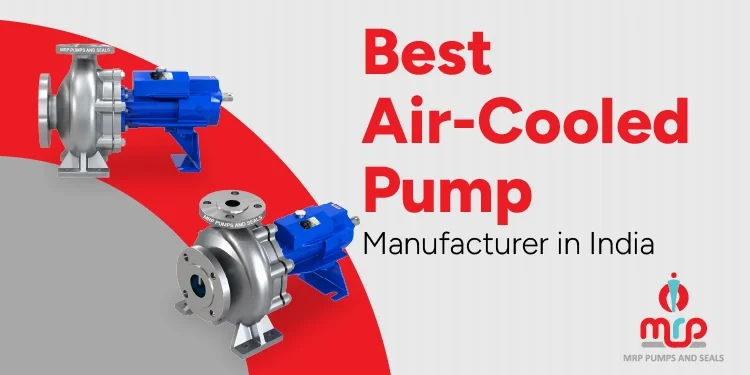
An air-cooled pump is an industrial pump that uses ambient air – not water – to cool the pump casing and motor during high-temperature fluid handling. It is designed for applications involving hot oil, thermic fluid, and heat transfer circuits where cooling water is unavailable, impractical, or costly.
The best air-cooled pump manufacturers in India is based in Ahmedabad, Gujarat – India’s most active industrial pump manufacturing hub. These manufacturers combine deep application experience with local supply chain advantages to deliver pumps rated for temperatures up to 350°C across chemical, refinery, thermic fluid, plywood, textile, sugar, and petrochemical industries.
MRP Pumps and Seals is a trusted industrial process pumps & seals manufacturer in Ahmedabad with 15+ years of experience supplying air-cooled pumps to India’s most demanding process industries. This guide covers everything you need to know – how air-cooled pumps work, where they are used, how to select one, and what to look for in a manufacturer.
Key Takeaways
- Air-cooled pumps circulate high-temperature fluids without any external cooling water supply.
- They are the go-to solution for thermic fluid heaters, hot oil circuits, refineries, and chemical plants.
- A finned bracket or canned motor design dissipates heat using ambient air – keeping the pump running safely at temperatures up to 350°C.
- Air-cooled pumps reduce operational costs by eliminating cooling water infrastructure, treatment, and upkeep.
- MRP Pumps, a leading industrial process pumps & seals manufacturer in Ahmedabad, supplies air-cooled pumps across India’s process industries.
- The right pump must be matched to fluid type, operating temperature, flow rate, and site conditions.
What Is an Air-Cooled Pump?
An air-cooled pump is a specially designed industrial pump that uses ambient air – not water – to cool the pump casing and mechanical assembly during operation.
It is built for high-temperature fluid handling. This includes hot oil, thermic fluid, heat transfer oil, and other process liquids that run at elevated temperatures in closed-loop systems.
The advantage: no cooling water is required. This simplifies installation, cuts utility costs, and removes the risk of water-side scaling or fouling.
How Does an Air-Cooled Pump Work?
Air-cooled pumps use a finned bracket housing or a canned motor design to manage heat without external water. Here is how the process works:
- The pump casing features finned surfaces that maximize contact between the hot casing and surrounding air.
- An auxiliary impeller (in canned motor models) circulates the process of fluid through an internal cooling loop.
- Convective heat transfer through the fins dissipates heat into the ambient air continuously.
- Bearings and mechanical seals are protected from thermal overload through this passive or active cooling mechanism.
- Secondary containment prevents process fluid from leaking even if the primary seal degrades.
What Are the Benefits of Air-Cooled Pumps?
Air-cooled pumps offer a range of practical advantages over conventional water-cooled or standard centrifugal pumps in high-temperature applications.
1. No Cooling Water Required – Plants in remote locations or areas with poor water quality benefit immediately. There is no need to treat, supply, or monitor a cooling water loop.
2. Lower Operating Costs – Removing the cooling water system reduces both capital expenditure and monthly utility spending. Maintenance cycles are simpler and less frequent.
3. Compact Installation Footprint – Air-cooled pumps do not require cooling towers, water tanks, or external heat exchangers. They fit directly into tighter plant layouts.
4. Safe Handling of Hazardous Fluids – Canned motor designs have no mechanical seal shaft penetration. This eliminates the most common leakage point – critical when handling flammable, toxic, or expensive process oils.
5. Extended Service Life – With fewer wear components and a well-managed thermal environment, air-cooled pumps typically deliver longer Mean Time Between Failures (MTBF) than water-cooled alternatives in the same service.
Which Industries Use Air-Cooled Pumps in India?
Air-cooled pumps are used wherever fluid temperatures exceed 80°C, and cooling water is a constraint or liability. Key sectors include:
- Thermic Fluid Heater Systems – hot oil circulation through industrial heating loops
- Plywood and Laminates – maintaining consistent press temperatures in board production
- Paper and Pulp Plants – managing high-temperature process fluid streams
- Refineries and Petrochemical Plants – transferring process hydrocarbons and oils safely
- Chemical Plants – handling hot, aggressive, or reactive liquids in closed circuits
- Fertilizer Plants – circulating reaction fluids at elevated process temperatures
- Sugar Mills – managing juice heating circuits and evaporation loop fluids
- IBR Boiler Systems – circulating fluids within regulated boiler heating systems
- Textile Dyeing Units – circulating heat transfer oils in dyeing and finishing machines
- Oil and Mining – handling high-temperature extraction and processing fluids
- Agro Industries – solvent extraction and oil processing at elevated temperatures
- Salt Plants – evaporation and brine concentration circuit fluid handling
If your process runs a high-temperature fluid loop, an air-cooled pump belongs in your specification.
Air-Cooled Pump vs. Water-Cooled Pump: Which Is Right for Your Plant?
This is the most common selection question our technical team handles. Here is a direct comparison:
Parameter | Air-Cooled Pump | Water-Cooled Pump |
Cooling medium | Ambient air (forced or natural convection) | External water supply circuit |
Max operating temperature | Up to 350°C | Up to 300°C (varies by design) |
Cooling water supply needed | No | Yes |
Risk of scaling or fouling | None | High in hard water zones |
Installation complexity | Low | Medium to high |
Maintenance requirements | Low | Medium (water loop upkeep) |
Best suited for | Remote sites, hot oil, thermic fluid circuits | High-load continuous processes |
Operating cost | Lower (no water utility) | Higher (treatment + supply) |
Leakage risk | Very low (canned motor option) | Medium (mechanical seal wear) |
Quick guidance: If cooling water is unreliable, expensive, or unavailable – choose air-cooled. If you run an extremely high-load continuous duty process with easy access to treated water – a water-cooled design may suit better. Our team at MRP Pumps can help you evaluate both options for your specific plant conditions.
What Should You Look for in an Air-Cooled Pump?
Choosing the right manufacturer matters as much as choosing the right pump. Here are the key criteria to evaluate:
1. Temperature Rating and Pressure Handling
The pump must be rated for your peak operating temperature – not just the normal range. Confirm the manufacturer can supply pumps rated up to 350°C for thermic fluid and hot oil service.
2. Material of Construction
Material selection directly affects seal integrity and service life. Common options:
- Cast Iron (CI) – general purpose, moderate temperature
- Carbon Steel (CS) – higher pressure, moderate to high temperature
- Stainless Steel (SS 304 / SS 316) – corrosive, hygienic, or high-purity applications
- Alloy Steel – extreme temperature and pressure conditions
3. Finned Bracket vs. Canned Motor Design
Finned bracket designs suit most thermic fluid applications. Canned motor designs offer zero-leakage performance for hazardous, flammable, or high-value process fluids.
4. Availability of Pump Spares
A pump is only as reliable as the spare parts support behind it. Confirm the manufacturer stocks critical spares – including impellers, mechanical seals, and bearing assemblies – and can deliver quickly.
5. Application Engineering Support
Air-cooled pump selection requires detailed knowledge of fluid viscosity, specific gravity, NPSH available, and temperature profile. A manufacturer who provides pre-sales technical consultation reduces the risk of wrong selection and premature failure.
Why is MRP Pumps a Trusted Air-Cooled Pump Manufacturer in Ahmedabad?
Ahmedabad is one of India’s most active industrial manufacturing hubs. Pump manufacturers based here hold structural advantages that directly benefit buyers across India.
Supply chain depth: Direct access to casting suppliers, motor manufacturers, and seal producers keeps lead times short and costs competitive.
Application experience: Ahmedabad manufacturers serve Gujarat’s dense industrial base – chemical, textile, pharma, sugar, and petrochemical – building real application knowledge over time.
Logistics: Road and air connectivity from Ahmedabad reaches every major industrial cluster in India efficiently.
MRP Pumps, a trusted industrial process pumps & seals manufacturer in Ahmedabad, has served process industries across India for 15+ years. Our air-cooled pump range covers hot oil service, thermic fluid systems, chemical transfer, and high-temperature process applications – backed by on-site technical consultation, installation support, and a readily available pump spares inventory.
How Do Air-Cooled Pumps Fit into a Broader Industrial Pump System?
In most plants, air-cooled pumps operate alongside a wider range of fluid handling equipment. Understanding this helps in total system planning:
- Centrifugal Process Pumps – handle primary process fluid at moderate temperatures
- Hot Oil Thermal Transfer Pumps – dedicated high-temperature thermic fluid service
- High Pressure Multistage Pumps – boost pressure in boiler feed or high-head circuits
- Metering Dosing System Plunger & Diaphragm Pumps – precise chemical injection alongside the hot oil circuit
- Polypropylene Centrifugal Pumps – corrosive chemical streams in adjacent process lines
- Multi-Purpose Rotary Gear Pumps – viscous oil and lubricant transfer in ancillary systems
- Liquid Ring Vacuum Pumps – vacuum service in distillation and evaporation stages
- Progressive Cavity Screw Pumps – high-viscosity fluid transfer in connected process steps
- Vertical Long Shaft Sump Pumps – sump drainage and tank emptying in hot fluid areas
Air-Cooled Pump Maintenance: A Practical Checklist
Air-cooled pumps are low-maintenance by design – but routine checks protect uptime and extend service life.
Daily
- Verify outlet temperature and pressure are within normal operating range
- Listen for unusual noise or vibration
- Confirm cooling fins are unobstructed and ambient air flow is clear
Weekly
- Check motor current draw against baseline
- Inspect external surfaces for discoloration or hot spots
Monthly
- Clean finned surfaces – dust buildup reduces cooling efficiency
- Inspect bearing wear indicator (if fitted)
- Check mechanical seal for weeping or leakage (on non-canned designs)
Annual Overhaul
- Disassemble and inspect impeller and casing wear ring
- Replace mechanical seal if showing wear
- Flush and inspect internal cooling loop (canned motor models)
- Verify alignment and coupling condition
- Test all safety instruments – temperature sensors, pressure gauges
Conclusion
Air-cooled pumps are the reliable, cost-effective solution for high-temperature fluid handling wherever cooling water is a constraint.
They simplify installation, reduce operating costs, and improve safety – especially in hot oil, thermic fluid, and chemical transfer applications.
Choosing the right manufacturer means verifying temperature ratings, material options, spare parts availability, and application engineering support. MRP Pumps and Seals – an established industrial process pumps & seals manufacturer in Ahmedabad – delivers all of this, with 15+ years of experience serving India’s most demanding process industries.
Contact us to learn about our complete pump range
from air-cooled pumps to slurry pumps and high-pressure multistage pumps.
Frequently Asked Questions
1. What is an air-cooled pump and how is it different from a standard pump?
An air-cooled pump uses ambient air – via finned surfaces or a canned motor – to manage heat during operation. Standard pumps need external cooling water for the same purpose. Air-cooled pumps are preferred when cooling water is unavailable, expensive, or a contamination risk.
2. What temperatures can an air-cooled pump handle?
Most industrial air-cooled pumps handle fluid temperatures up to 350°C. The specific limit depends on casing material, impeller design, and sealing arrangement. Always confirm peak temperature ratings with the manufacturer before finalising selection.
3. Which industries use air-cooled pumps most in India?
Thermic fluid heater systems, plywood and laminate plants, refineries, chemical plants, sugar mills, IBR boiler systems, textile dyeing units, fertilizer plants, and paper mills are the most common users across India.
4. Do air-cooled pumps require cooling water?
No. That is their primary advantage. Cooling is achieved entirely through the finned bracket housing or canned motor cooling loop using ambient air. No external water supply or treatment is needed.
5. What is a canned motor air-cooled pump?
A canned motor pump uses a hermetically sealed motor with no shaft passing through the pump casing. This eliminates the mechanical seal – the most common source of leakage in conventional pumps. It is the preferred design for flammable, toxic, or high-value process fluids.
6. What materials are used in air-cooled pump construction?
Common materials include cast iron, carbon steel, stainless steel (SS 304 / SS 316), and alloy steel. Material selection depends on fluid chemistry, operating temperature, and system pressure. Corrosive applications typically require SS 316 or specialist alloys.
7. How do I select the right air-cooled pump for my plant?
Start with four parameters: fluid type, operating temperature (normal and peak), required flow rate (m/hr), and total head (metres). Also confirm whether your site has any ATEX zone classification or IBR compliance requirements. MRP Pumps’ technical team can assist with full selection guidance.
8. Where can I source air-cooled pumps and spare parts in India?
MRP Pumps, based in Ahmedabad, supplies air-cooled pumps and a comprehensive range of pump spares across India. Our team supports buyers from initial selection through to installation, commissioning, and ongoing maintenance.