


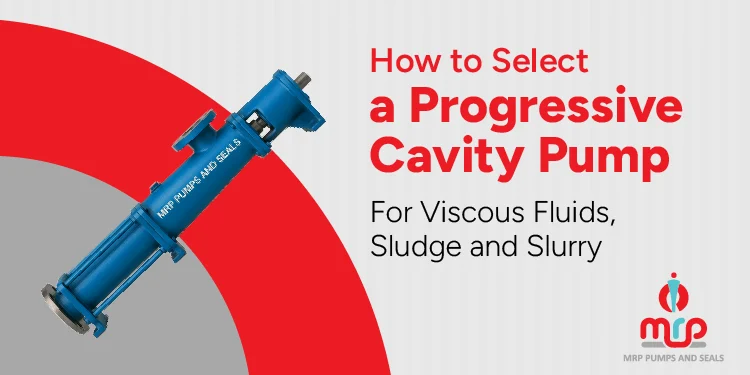
A progressive cavity pump can handle fluids that cause severe performance loss, excessive shear, or high power demand in a conventional centrifugal pump, but only when the rotor, stator, drive, and suction conditions are matched to the actual process duty.
Many selection mistakes happen for the same reason: the fluid is treated as “thick” or “dirty” without checking the specific properties that determine pump performance. Viscosity, particle size, solids concentration, and shear sensitivity each push the design in a different direction.
This guide walks through what to check before specifying a progressive cavity pump for sludge, slurry, or high-viscosity transfer, how rotor and stator selection affects service life, and when a centrifugal or alternative pump type is actually the better fit.
Key Takeaways
- Positive Displacement Suits Many Thick Fluids: Progressive cavity pumps provide smooth, low-pulsation flow and can maintain predictable performance on high-viscosity or shear-sensitive duties where conventional centrifugal pump performance may decline.
- Viscosity Alone Does Not Decide the Pump: Solids concentration, particle size, and abrasiveness matter as much as viscosity when sizing a progressive cavity pump.
- Rotor and Stator Material Drives Service Life: Elastomer selection for the stator, and metal or coating selection for the rotor, determines how the pump handles abrasive slurry and chemical exposure.
- Dry Running Destroys Stators Fast: Progressive cavity pumps rely on the pumped fluid to lubricate the stator; running dry, even briefly, can cause rapid, irreversible wear.
- Flow Generally Tracks Pump Speed: Theoretical displacement is proportional to rotational speed, although actual delivered flow can vary because of pressure-dependent slip, fluid properties, wear, and suction conditions.
- Shear-Sensitive Fluids Need Low-Shear Handling: Food, pharmaceutical, and biological slurries often require progressive cavity pumps specifically because centrifugal impellers damage the product.
- Sizing Requires Real Duty Data: Flow rate, differential pressure, viscosity at operating temperature, and solids characteristics should come from actual process conditions, not assumptions.
- Maintenance Access Affects Total Cost: Pull-out or split-case designs that allow rotor and stator replacement without disturbing piping reduce downtime in slurry and sludge service.
What Is a Progressive Cavity Pump and How Does It Move Thick Fluids?
A progressive cavity pump moves fluid using a helical metal rotor turning inside a resilient stator with a matching internal helix. As the rotor turns, it forms a series of sealed cavities that progress from suction to discharge.
This is a positive displacement mechanism, not a centrifugal one. Each rotation provides a defined theoretical displacement, while actual delivered flow is influenced by speed, differential pressure, fluid properties, pump geometry, and internal slip.
The interference fit between rotor and stator creates the seal that makes this possible. That same interference fit is also the reason material selection, alignment, and dry-running protection matter more here than in most other pump types.
Why Can Standard Centrifugal Pumps Struggle With High-Viscosity Sludge or Slurry?
Centrifugal pumps rely on impeller velocity to generate head, and that mechanism loses efficiency fast as viscosity rises. Above a certain viscosity, the pump curve flattens, motor loading increases, and the pump can no longer deliver its rated flow and head together.
Solids content compounds the problem. In conventional centrifugal pumps not designed for abrasive duty, solids can accelerate impeller and casing wear, while fibrous material may restrict or clog narrow flow passages.
Shear is the third issue. Centrifugal impellers apply high mechanical shear to the fluid, which is acceptable for water or thin chemicals but can break down flocs in sludge, damage food products, or destabilize emulsions.
What Fluid Properties Should You Check Before Selecting a Progressive Cavity Pump?
Before specifying a pump, confirm the properties below rather than estimating them from a general description like “thick” or “dirty.”
| Factor | Why It Matters | What to Check |
| Viscosity at operating temperature | Determines pump sizing, speed, and motor loading | Measured viscosity at actual process temperature, not ambient |
| Solids concentration | Affects rotor and stator wear rate and clearance requirements | Percentage solids by weight or volume |
| Particle size and hardness | Drives abrasion resistance and clearance design | Maximum particle size and material hardness |
| Shear sensitivity | Determines whether low-shear handling is required | Whether the fluid structure (flocs, product integrity) must be preserved |
| Chemical compatibility | Determines elastomer and metallurgy selection | Full fluid composition, pH, and any solvents present |
| Suction condition | Affects priming and NPSH available at the pump inlet | Suction lift, line length, and any entrained air |
For lower-viscosity abrasive slurry where high flow and solids handling are the main requirements, it is also worth comparing a centrifugal slurry pump with a progressive cavity pump. Skipping this step is the most common reason a pump underperforms after installation.
If your process involves lower-viscosity sludge or wastewater with moderate solids, it is also worth comparing a sewage and mud pump against a progressive cavity design, since the two serve overlapping but distinct duty ranges.
If you are unsure whether your application needs a progressive cavity pump or a different pump family entirely, our team at MRP Pumps can review your fluid data before you commit to a pump type.
Need Help Selecting the Right Progressive Cavity Pump?
Share your flow, pressure, viscosity, and solids data with our team for application-based pump selection.
How Does Rotor and Stator Material Affect Slurry and Sludge Performance?
The stator and rotor are key wear components in abrasive slurry and sludge service, so their material selection has a major influence on maintenance frequency and pump performance.
Elastomer choice depends on chemical exposure and temperature. Nitrile, EPDM, and fluoroelastomer compounds each resist different chemicals and temperature ranges, and the wrong choice can cause the stator to swell, harden, or degrade well before its expected service life.
Rotor coatings and finishes matter separately from elastomer choice. Abrasive slurry wears an uncoated or soft rotor surface quickly, increasing clearance and reducing volumetric efficiency long before the stator itself fails.
Abrasion resistance and chemical compatibility sometimes pull in opposite directions. A progressive cavity screw pump specified correctly balances both against the actual fluid, rather than defaulting to a generic elastomer because it is the standard catalog option.
What Flow and Pressure Factors Determine Pump Sizing?
Progressive cavity pump flow is close to linear with rotor speed, which makes sizing more predictable than with centrifugal pumps, provided the input data is accurate.
Sizing should be based on actual required flow rate, total differential pressure across the system, and the viscosity of the fluid at its real operating temperature, not at ambient conditions where a sample might be tested.
Pressure capability depends mainly on the pump’s number of stages and the permissible differential pressure per stage for the selected rotor-stator geometry. Rotor/stator pitch, diameter, eccentricity, and lobe geometry also influence displacement and overall pump performance.
Duty cycle also affects sizing. A pump running continuously at a fixed rate has different wear and thermal considerations than one cycling frequently or operating at variable speed for dosing-style control.
Selecting the wrong elastomer or stage count for a slurry duty often costs more in downtime than the pump itself. Our team can help match rotor, stator, and stage configuration to your actual process fluid before you finalize a specification.
Match the Pump to Your Actual Sludge or Slurry Duty
MRP Pumps can help review viscosity, solids concentration, particle size, and operating conditions before you finalize the pump configuration.
Progressive Cavity Pump vs Centrifugal Pump: Which Is Right for Your Application?
| Pump Type | Fluid | Solids / Viscosity | Typical Application |
| Progressive Cavity Pump | Viscous, shear-sensitive, or solids-laden fluids | High viscosity, high solids, low shear tolerance | Sludge, slurry, thick chemicals, dosing |
| Centrifugal Process Pump | Thin to moderately viscous, low-solids fluids | Low to moderate viscosity, low abrasive solids | General chemical transfer, water, process circulation |
Neither pump type is universally better. A progressive cavity pump is the right choice when viscosity, solids content, or shear sensitivity make centrifugal operation inefficient or damaging to the product. A centrifugal pump remains the simpler, lower-cost option for thinner, cleaner fluids at higher flow rates.
Where Are Progressive Cavity Pumps Typically Used in Industrial Sludge and Slurry Duty?
Progressive cavity pumps are common wherever fluid consistency and solids content rule out a centrifugal pump.
- Wastewater and effluent treatment: dewatered sludge, thickened sludge, and polymer-dosed sludge transfer
- Mining and mineral processing: thickened tailings and viscous slurry where particle settling and abrasion are ongoing concerns
- Chemical and process industries: viscous chemicals, resins, and pastes that would shear or degrade in a centrifugal impeller
- Food and beverage processing: low-shear transfer of products where structure and consistency must be preserved
- Paper and pulp: stock and sludge transfer at higher consistency than centrifugal designs can efficiently handle
Fluid properties, not the industry name, ultimately decide the pump. Two sludge streams from the same plant can require different rotor, stator, and sizing decisions if their solids content or particle size differs.
What Selection Mistakes Lead to Premature Wear or Failure?
Most premature progressive cavity pump failures trace back to a small number of avoidable mistakes.
- Sizing the pump on nominal viscosity instead of the viscosity at actual operating temperature
- Selecting a standard elastomer without checking chemical compatibility against the full fluid composition
- Ignoring maximum particle size, which accelerates rotor and stator wear
- Allowing the pump to run dry during startup, priming, or a supply interruption
- Running the pump faster than necessary to compensate for undersizing, which increases abrasive wear
Many of these failures originate from selection, application, or operating conditions rather than an inherent problem with the pump technology.
What Maintenance Does a Progressive Cavity Pump Need in Slurry Service?
Progressive cavity pumps in slurry and sludge duty need routine wear monitoring rather than complex maintenance procedures. Volumetric efficiency, discharge pressure at a given speed, and current draw are practical early indicators of rotor or stator wear.
Access for rotor and stator replacement matters more in slurry service than in cleaner duty, since replacement intervals are typically shorter. Pumps that allow service without disturbing suction and discharge piping reduce both downtime and labor cost.
Keeping a stock of wear parts on hand, rather than ordering after a failure, is common practice for continuous slurry and sludge duty. Keeping suitable wear parts available can help reduce maintenance delays. MRP Pumps also provides pump spares for maintenance requirements.
Conclusion
Selecting a progressive cavity pump for viscous fluids, sludge, or slurry comes down to matching real fluid data, not a general description, to rotor material, stator elastomer, and sizing. Viscosity at operating temperature, solids concentration, particle size, and shear sensitivity each shape the final specification.
Getting this right the first time avoids the two most common outcomes of poor selection: a pump that underperforms from day one, or one that wears out far faster than expected. If you are specifying a progressive cavity pump for a sludge, slurry, or high-viscosity application, MRP Pumps can review your flow, pressure, and fluid data from our facility in Ahmedabad, Gujarat, and recommend a suitable configuration. Reach our team at mrppumps@gmail.com or +91 98259 69278.
Looking for a Progressive Cavity Pump for Your Process?
Discuss your viscous fluid, sludge, or slurry application with MRP Pumps and get help identifying a suitable pump configuration.
Frequently Asked Questions
1. How do I know if I need a progressive cavity pump instead of a centrifugal pump?
If your fluid is highly viscous, contains significant solids, or must not be sheared or broken down, a progressive cavity pump is typically the better fit. Thinner, cleaner, low-solids fluids are usually more economical to pump with a centrifugal design.
2. What viscosity range can a progressive cavity pump handle?
Progressive cavity pumps are used across a very wide viscosity range, from near-water fluids up to extremely thick pastes and slurries. The exact limit depends on the specific pump design, rotor and stator geometry, and available drive power.
3. Can a progressive cavity pump handle abrasive slurry?
Yes, with the correct rotor coating, stator elastomer, and reduced operating speed to limit wear. Abrasive duty generally requires a different material specification than clean or lightly loaded fluid transfer.
4. How does elastomer selection affect pump life in sludge duty?
The stator elastomer must resist the specific chemicals, temperature, and abrasion present in the fluid. An incompatible elastomer can swell, harden, or wear prematurely, shortening service life regardless of how well the rest of the pump is sized.
5. What causes a progressive cavity pump stator to fail prematurely?
Common causes include dry running, chemical incompatibility between the fluid and elastomer, oversized particle content, and running the pump faster than the duty requires. Most stator failures trace back to one of these factors.
6. Can a progressive cavity pump run dry?
No. Progressive cavity pumps generally require the pumped fluid to lubricate and cool the rotor-stator interface. Dry running can rapidly overheat and damage the stator, so dry-running protection should be considered where loss of feed is possible.
7. How is a progressive cavity pump sized for flow and pressure?
Sizing uses required flow rate, total differential pressure, and viscosity at actual operating temperature. Because flow scales close to linearly with speed, accurate input data produces a reliable sizing result.
8. What maintenance does a progressive cavity pump need in slurry service?
Routine monitoring of volumetric efficiency, discharge pressure, and motor current helps catch rotor and stator wear early. Planned rotor and stator replacement, supported by available spares, keeps unplanned downtime low.