


Key Takeaways
- Centrifugal pumps excel at high flow, moderate pressure, and energy efficiency—especially with clean, low-viscosity fluids. They’re the backbone of industrial transfer.
- Positive displacement pumps deliver constant flow, handle high viscosity, and tolerate high pressure—ideal for metering, testing, and difficult fluids.
- Your selection depends on five factors: flow rate needed, operating pressure, fluid viscosity, required flow vs. pressure constancy, and maintenance capability.
- Matching application to pump type avoids expensive mistakes and ensures years of reliable service.
- Industry expertise matters. Thermic fluid heaters need centrifugal; chemical metering needs positive displacement; slurry operations need specialized variants.
Introduction
Choosing the right pump for your industrial application is not just about specifications—it is about understanding what your fluid needs and how different pump technologies deliver those needs. Get it wrong, and you are facing inefficient operations, maintenance headaches, and unexpected downtime. Get it right, and you unlock reliability, cost savings, and optimal performance.
Here’s the fundamental question every plant manager should ask: Does my application need high flow with lower pressure, or precise flow control with high pressure? This single distinction determines whether you need a centrifugal pump or a positive displacement (PD) pump.
At MRP Pumps and Seals, we have helped industrial facilities across thermic fluid heating, chemical processing, petrochemical, mining, and refinery operations select the exact pump that matches their operational reality. In this guide, we will break down how to choose between these two pump families and walk through the selection criteria that matter.
What are Centrifugal Pumps?
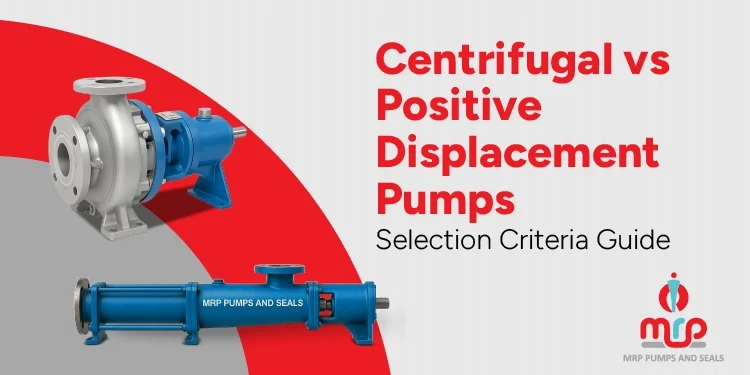
Centrifugal pumps are the most common industrial pumps, specifically engineered to transport low-viscosity fluids such as water and thin chemicals.
They function by utilizing a rotating component called an impeller. As the impeller spins, it creates a vacuum that draws liquid in and then accelerates it outward using a powerful centrifugal force.
This rapid movement converts kinetic energy into hydrodynamic pressure, effectively pushing the fluid through the system. Because of this efficient design, they are the standard choice for applications that demand high flow rates and continuous operation.
What is Positive Displacement (PD) Pumps?
Positive Displacement (PD) pumps are specialized devices engineered for challenging industrial tasks involving high viscosity, high pressure, or precise dosing requirements.
Unlike centrifugal options, they operate by capturing a specific, fixed volume of fluid within a cavity using mechanisms like gears, screws, or plungers.
This trapped fluid is then mechanically forced into the discharge pipe, ensuring a constant and reliable flow rate regardless of changes in system back-pressure. This distinct operating principle makes it essential for transporting thick, difficult materials such as heavy oils, sludges, and pastes where other pump types might fail.
The Core Difference Between Centrifugal vs. PD Pumps?
The fundamental difference lies in the physics of how they move fluid.
Feature | Centrifugal Pumps | Positive Displacement (PD) Pumps |
Mechanics | Uses rotational speed (Kinetic) | Uses trapped volume (Force) |
Viscosity | Best for thin fluids (Water, Solvents) | Best for thick fluids (Oils, Pastes) |
Flow Rate | Varies with pressure (Head) | Constant flow, regardless of pressure |
Pressure | Limited capability | Can generate very high pressures |
Shearing | High shear (can damage delicate fluids) | Low shear (gentle handling) |
Priming | Usually requires priming | Generally self-priming |
When Do You Need a Centrifugal Pump?
Your application is ideal for centrifugal pumps if you need:
- High flow rates (100+ GPM) with moderate to low pressure heads
- Energy efficiency on low-viscosity fluids (water, light oils, thin slurries)
- Simple maintenance with fewer moving parts exposed to the pumped fluid
- Lower capital cost for standard industrial duty
- Better performance with clean or lightly contaminated fluids
Best Applications for Centrifugal Pumps
Thermic fluid circulation in heaters demands reliable, efficient pumping—and centrifugal pumps excel here. The thermal fluid flows consistently, viscosity is manageable, and high throughput is essential.
Other ideal applications include:
- Cooling water systems in refineries and chemical plants
- General transfer in paper mills and plywood operations
- Agricultural irrigation and fertigation systems
- Sewage and wastewater handling (where sewage mud pumps provide specialized solutions)
- Slurry transport in mining and fertilizer plants (via specialized slurry pumps)
The Centrifugal End Suction Pump and Horizontal Single Stage Suction Pump from MRP’s catalog are workhorses in these settings, offering dependable service with minimal operator attention.
A fertilizer plant moving ammonium nitrate solution at 150 GPM across a 20-foot head doesn’t need the precision of a positive displacement pump—a standard centrifugal monoblock pump handles it efficiently while keeping energy costs predictable.
When Do You Need a Positive Displacement Pump?
Your application demands a PD pump if you have:
- High-viscosity fluids (oils, polymers, resins) that slow or resist flow
- Low flow rates with very high pressure (constant output regardless of backpressure)
- Metering or dosing requirements where accuracy matters
- Variable-load conditions were pressure changes significantly
- Difficult fluids—sticky, abrasive, or corrosive materials that need precise control
Best Applications for Positive Displacement Pumps
Chemical injection and metering represent the sweet spot for PD pumps. When you’re adding catalyst, dye, or treatment of chemicals at precise ratios, a Metering Plunger Pump or Metering Dosing System Plunger Diaphragm Pump gives you the repeatability of centrifugal pumps simply cannot match.
High-viscosity thermal fluid transfer—oil at 40,000 SSU isn’t moving efficiently through a centrifugal pump’s impeller. A Hot Oil Thermal Transfer Pump or Multi-Purpose Rotary Gear Pump handles this without cavitation or efficiency loss.
Common PD applications include:
- Polymer and resin transfer in chemical plants
- High-pressure testing and hydraulic applications (via Motorized Hydraulic Test Pump)
- Progressive cavity (screw) pumping for difficult fluids
- Fuel and lubricant transfer in refineries
- Vacuum and vapor recovery systems (via Liquid Ring Vacuum Pump)
- Precise chemical metering in sugar processing
A petrochemical plant needs to pump viscous bitumen at exactly 50 PSI into a reactor. A centrifugal pump would cavitate or recirculate fluid uselessly. A Progressive Cavity Screw Pump delivers every gallon at that pressure, predictably.
Centrifugal vs Positive Displacement
Criterion | Centrifugal Pump | Positive Displacement Pump |
Flow Rate Capacity | High (100+ GPM typical) | Low to moderate (10-100 GPM) |
Maximum Pressure | Moderate (50-150 PSI typical) | High (500+ PSI achievable) |
Efficiency at Design Point | 70-85% | 75-90% |
Viscosity Tolerance | Low (thin fluids only) | High (up to 100,000 SSU) |
Pressure Sensitivity | Flow drops as pressure increases | Flow remains constant as pressure increases |
Cavitation Risk | High risk with vaporous fluids | Low risk |
Cost | $1,500-$15,000 (standard models) | $3,000-$25,000+ (specialized designs) |
Maintenance Frequency | 500-2,000 operating hours | 1,000-3,000 operating hours |
Seal/Bearing Wear | Low (simpler internal geometry) | Moderate to high (close tolerances) |
Speed Range | 500-3,500 RPM typical | 500-1,500 RPM typical |
NPSH Requirement | High (critical consideration) | Low |
Step-by-Step Industrial Pump Selection Process
1. What’s Your Flow Rate Requirement?
Start here. If you need consistent, high-volume transfer of clean or lightly contaminated fluids, centrifugal pumps will win efficiency and cost. MRP’s Centrifugal End Suction Pump line handles 50-500+ GPM across industrial duty ranges.
If your process needs precise, lower-volume output (especially metering), positive displacement wins. A Metering Plunger Pump delivers 0.5-50 GPM with tight tolerance.
Calculate your actual flow requirement in GPM. This single number eliminates 50% of unsuitable options.
2. What Pressure Must the Pump Handle?
Centrifugal pumps are pressure sensitive. As system resistance increases, centrifugal output drops dramatically along their curves. If you have intermittent high-pressure spikes, the pump unloads.
Positive displacement pumps don’t care. Pressure might increase, but volume stays constant until motor overload.
For thermic fluid heaters: Typical 40-60 PSI system head? Centrifugal is perfect. For Hot Oil Thermal Transfer Pumps, MRP provides optimized impeller designs for this exact duty.
For high-pressure injection: 300+ PSI consistently? You need positive displacement. MRP’s High Pressure Triplex Plunger Pump or High-Pressure Multistage Pump won’t flinch.
Graph your system resistance curve. Where does your operating point typically land?
3. What’s Your Fluid Viscosity?
This is where centrifugal and positive displacement diverge most dramatically.
Light fluids (SAE 10W oil, water, thin chemical solutions) flow easily through centrifugal impellers. High-viscosity fluids (SAE 50 oil, bitumen, polymers) choke centrifugal designs—efficiency drops to 30-40%, and cavitation risk spikes.
Positive displacement pumps love viscosity. A screw or gear pump’s efficiency improves as viscosity increases because internal leakage decreases.
For thermic fluid: Centrifugal is standard and highly efficient.
For industrial oils, polymers, and resins: Progressive cavity or rotary gear designs are mandatory. MRP’s Multi-Purpose Rotary Gear Pump handles viscosities up to 1,000,000 cSt without breaking a sweat.
Get your fluid viscosity grade (cSt at operating temperature). If it exceeds 500 cSt, seriously consider positive displacement.
4. Do You Need Constant Flow or Constant Pressure?
A centrifugal pump maintains relatively constant pressure but variable flow. As system resistance changes, pressure holds, but volume backs off.
A positive displacement pump delivers constant flow regardless of pressure. Pressure adjusts to system resistance; volume doesn’t.
In metering applications (adding chemicals, dosing treatments), you need constant flow. A centrifugal pump that reduces output when backpressure increases ruin your process ratios. This is why MRP’s Metering Dosing System Plunger Diaphragm Pump is essential in sugar processing, water treatment, and chemical manufacturing.
5. What’s Your Maintenance and Downtime Tolerance?
Centrifugal pumps are simple, robust, and forgiving. Bearing and seal maintenance is routine and inexpensive. Many facilities run centrifugal pumps 5+ years between major overhauls.
Positive displacement pumps have tighter internal clearances and greater sensitivity to fluid contamination. Wearing is more aggressive, and maintenance intervals are tighter.
In heavy industries (paper mills, chemical plants, refineries) running 24/7, the robust simplicity of centrifugal pumps is attractive.
In precision-critical operations (metering, testing, vacuum), the reliability advantage of constant-flow positive displacement pumps justifies more frequent maintenance.
Application-Specific Guidance by Industry
1. Thermic Fluid Heater Operations
Clear winner: Centrifugal. Thermal fluid is clean, consistent with viscosity, and requires high flow at moderate pressure. MRP’s Hot Oil Thermal Transfer Pump and Air-Cooled Pump are purpose-designed for this duty, with optimal impeller geometry for 32-68 cSt oils.
2. Petrochemical Refining
Mixed application: Use centrifugal for general transfer (water, light crude), positive displacement for heavy fractions, bitumen, and metering. MRP serves both—from Centrifugal Monoblock Pump (general duty) to High Pressure Triplex Plunger Pump (injection and testing).
3. Chemical and Fertilizer Plants
Most of the positive displacement. Metering, viscous compounds, and variable pressure demands favor PD. However, water transfer and cooling circuits use centrifugal. Balanced inventory is essential.
4. Mining and Slurry Operations
Specialized in centrifugal. Abrasive slurries and mud require Slurry Pump or Sewage Mud Pump designs with reinforced internals. Standard centrifugal can’t handle sand and grit; these engineered variants can.
How to Avoid the Most Expensive Mistakes
1. Oversizing pressure capacity. Buying a pump rated for 300 PSI when your system needs 60 PSI costs you 20-30% in energy and capital. Match pressure rating to actual duty.
2. Ignoring viscosity. Installing a centrifugal pump on a 5,000 cSt resin leads to cavitation, seal failure, and sudden outages. Respect fluid properties.
3. Underestimating contamination. Positive displacement pumps in dirty fluid environments fail faster. Clean your inlet or choose a pump designed for it.
4. Chasing the lowest upfront cost. A $2,000 centrifugal that runs 15 years is better than a $800 “deal” that fails in 18 months. Total cost of ownership wins.
5. Not consulting pump curves. Every pump has a performance curve. Your operating point must land in the efficient, stable zone—not at the edge where cavitation or overheating waits.
Conclusion: Why MRP Pumps and Seals Is Your Partner for This Decision
At MRP Pumps and Seals, we don’t just sell pumps—we solve flow problems. Our product range spans the full spectrum:
For centrifugal applications, we offer Centrifugal End Suction Pumps, Hot Oil Thermal Transfer Pumps, Slurry Pumps, Sewage Mud Pumps, and High Flow Low Head/Mix Flow Pumps—each engineered for its specific duty.
For positive displacement needs, we provide Multi-Purpose Rotary Gear Pumps, Progressive Cavity Screw Pumps, High Pressure Triplex Plunger Pumps, Metering Plunger Pumps, Metering Dosing System Plunger Diaphragm Pumps, and Liquid Ring Vacuum Pumps—backed by technical expertise in viscous, metering, and vacuum applications.
For specialized industries, we’ve delivered solutions in thermic fluid heating, chemical processing, petrochemical refining, paper manufacturing, fertilizer production, mining, and sugar processing.
The wrong pump choice costs thousands of energy waste, unexpected maintenance, and downtime. The right choice runs reliably for years while delivering consistent performance.
Don’t let pump selection become an afterthought. The right choice is the one that matches your real operating conditions—not your neighbor’s recommendation or the salesman’s default option.
If you’re unsure which pump family fits your application, contact us. We’ve solved flow problems across every major industrial sector. Let’s solve yours.
Frequently Asked Questions
1. Can I use a centrifugal pump if my fluid is slightly viscous?
Yes, up to about 300 cSt with acceptable efficiency (60-70%). Beyond that, positive displacement is strongly recommended. At 500+ cSt, centrifugal pumps become unreliable.
2. What’s the cavitation, and why does it matter?
Cavitation occurs when fluid pressure drops below vapor pressure, causing vapor bubbles to form and collapse violently inside the pump. It damages impellers, causes noise, and reduces efficiency. Centrifugal pumps are cavitation-prone with hot, low-pressure inlet conditions or high-viscosity fluids. Positive displacement pumps tolerate inlet conditions far better.
3. Do positive displacement pumps cost more to maintain?
Generally, yes. Tighter internal tolerances mean greater sensitivity to contamination and faster wear. Budget 30-50% higher maintenance costs, offset by longer intervals between routine service in clean-fluid applications.
4. Which pump is more energy-efficient?
Centrifugal pumps at their design point (60-80% of maximum flow) are 5-10% more efficient than positive displacement alternatives. However, positive displacement pumps maintain efficiency across a wide range of pressure. For variable-pressure applications, the advantage shifts to PD.
5. Can I switch from centrifugal to positive displacement without redesigning my system?
Not typical. PD pumps have much higher pressure, requiring reinforced piping, different relief valve settings, and potentially new motor sizing. Plan for system redesign if switching families.
6. What’s the typical lifespan of each pump type?
Centrifugal pumps in steady, clean-fluid duty last 10-15 years with routine seal and bearing maintenance. Positive displacement pumps in proper service last 5-10 years before major overhaul, depending on fluid cleanliness and duty severity.
7. How do I choose between rotary gear, screw, and piston positive displacement pumps?
Rotary gear is simplest, lowest cost, moderate viscosity tolerance. Progressive cavity (screw) handles higher viscosity and abrasive solids better. Piston (triplex plunger, etc.) delivers the highest pressure but requires the cleanest fluids. Match your viscosity and pressure needs.