


Quick Takeaways
- Centrifugal pumps use spinning motion to move dye solutions, water, and chemicals across textile plants
- Key types: end suction, inline, and polypropylene pumps – each fits different textile needs
- Benefits: saves energy, fights rust, needs less maintenance – handles high flow rates in dyeing
- Used in dyeing, washing, bleaching, printing, and water treatment across textile operations
- Right pump selection extends equipment life by 40–60% – matches chemicals and flow needs
- MRP Pumps offers textile-specific solutions – backed by 15+ years in Ahmedabad
What Are Centrifugal Pumps and Why Do Textiles Need Them?
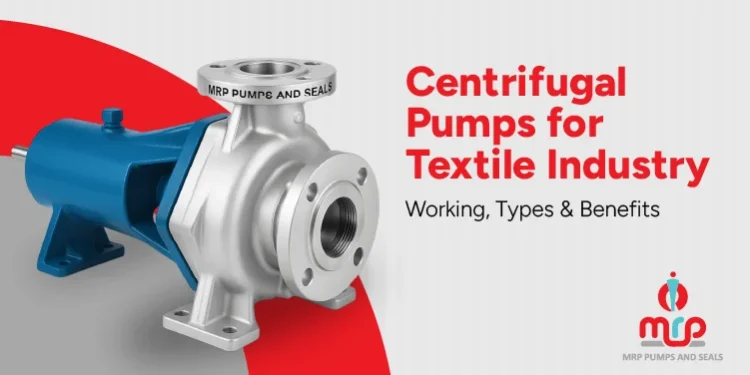
Centrifugal pumps turn spinning energy into fluid movement. They move liquids from one place to another using rotation. In textile plants, these pumps handle water, dye chemicals, and hot liquids every day.
The textile industry needs pumps that work with many fluid types. One production line might use water at 150°C, caustic soda, reactive dyes, and wastewater. All within the same shift.
Centrifugal pumps work well here. Their simple design has few moving parts. This reduces contamination risks. It also delivers steady performance across different applications.
These pumps maintain consistent flow rates. This matters when handling diverse chemical compositions. Textile operations depend on this reliability daily.
How Do Centrifugal Pumps Work in Textile Applications?
1. The Basic Operating Principle
A spinning impeller creates a force that pushes fluid outward. The motor drives a shaft. The impeller blades spin at high speed. This rotation speeds up the liquid from center to edge.
Fluid enters through the impeller center. It exits at the outer edge with more speed and pressure. This continuous flow design prevents pulsation.
In textile plants, this handles both water and chemical mixtures. The steady flow is critical. It maintains precise dye concentrations. It also keeps chemical dosing ratios correct.
2. Major Components Working Together
The pump casing turns speed into pressure. Fluid slows down in the expanding space. The mechanical seal stops hazardous dye chemicals from leaking out.
Wear rings keep the pump efficient. They control internal gaps. For textile work with abrasive slurries, hardened parts resist wear. They last over 5,000 operating hours.
Bearings support the shaft. They handle loads from the spinning impeller. In 24/7 textile operations, proper lubrication matters. It extends maintenance time from weeks to months.
At MRP Pumps, our Centrifugal Process Pumps use textile-grade seals. They handle pH ranges from 2 to 12. No degradation occurs over time.
What Types of Centrifugal Pumps Suit Textile Manufacturing?
1. Centrifugal End Suction Pumps
Best for: Water supply, dye prep, and washing.
End suction pumps have horizontal shafts. The suction is on one end. Discharge is on top or side. They’re compact and easy to install.
They handle moderate flow rates of 50–500 GPM. Heads reach up to 100 meters. Textile units use these for moving dye baths. From mixing tanks to dyeing machines.
Installation is simple. Mount on a baseplate. Connect the suction pipe. Align with a motor. Done.
Our Centrifugal End Suction Pumps at MRP Pumps have rust-resistant coatings. They work with textile chemicals safely.
2. Vertical Inline Centrifugal Pumps
Best for: Tight spaces, cooling systems, and circulation.
These pumps save 60–70% of floor space. The motor sits on top of the pump. This creates a vertical setup.
Textile facilities with limited room use inline pumps. They recirculate hot water in stenters. They maintain pressure in spray dyeing systems.
Maintenance is easier. You can service the pump without disconnecting pipes. This cuts downtime from 4–6 hours to under 2 hours.
Flow ranges from 20 to 800 GPM. Heads reach up to 150 meters. The Vertical Inline Centrifugal Pump from MRP handles up to 120°C. Perfect for textile finishing.
3. Polypropylene Centrifugal Pumps
Best for: Strong acids, alkalis, and corrosive chemicals.
Polypropylene resists aggressive chemicals. These destroy metal pumps quickly. They handle sulfuric acid, sodium hypochlorite, and reactive dyes. No corrosion occurs.
Temperature limits reach 90°C. This fits most textile chemical processes.
Chemical resistance is unmatched. Polypropylene doesn’t react with chlorides or peroxides. It resists organic solvents common in textile work. Maintenance costs drop by 40% versus stainless steel.
Our Polypropylene Centrifugal Pumps are tested with textile chemicals. They deliver 10,000+ hour service life.
4. Close Coupled Centrifugal Pumps
Best for: Compact setups, cooling towers, and backup systems.
The impeller mounts directly on the motor shaft. No separate coupling is needed. No baseplate is required.
This design cuts installation cost by 30%. It eliminates alignment problems. Textile plants use these for cooling tower circulation. Also, for filter press feeding and utility water.
Energy efficiency improves by 5–8%. No coupling loss occurs. Footprint reduces by 50% versus traditional pumps.
The Close Coupled Centrifugal Pumps we supply deliver 10 to 300 GPM. With minimal power use.
5. Horizontal Single Stage Side Suction Pumps
Best for: High flow, wastewater transfer, and irrigation.
Side suction makes pipe routing easier. Works well in crowded textile facilities. Single-stage design keeps maintenance simple. Handles large volumes up to 2,000 GPM.
These pumps move treated wastewater to storage or to irrigation systems.
Installation is flexible. You adapt to existing pipes. No expensive changes are needed. Cast iron handles mildly abrasive wastewater. It manages to lint and dye particles.
Our Horizontal Single Stage Side Suction Pumps have oversized passages. This prevents clogging from textile waste.
6. Centrifugal Monoblock Pumps
Best for: Portable use, small operations, and emergency backup.
Motor and pump in one unit. Just plug in and start pumping. Great for small dyeing units. Works as an emergency backup when main pumps need service.
Flow rates range from 5 to 100 GPM. Heads reach up to 50 meters.
Zero alignment hassles. Fast to set up. During line modifications, monoblock pumps keep things running.
The Centrifugal Monoblock Pumps in our range start within seconds. Minimal training is needed.
What Are the Benefits of Using Centrifugal Pumps in Textiles?
1. High Efficiency with Variable Flow Rates
Centrifugal pumps deliver 70–85% efficiency at design points. They handle flow changes without damage. During batch dyeing, the needs change from 200 GPM filling to 50 GPM circulation.
Centrifugal pumps adapt smoothly. Adjust motor speed or valve position. Simple.
Energy use matches flow directly. Cut flow by 20% and power drops by about 50%. This flexibility saves 15–25% on yearly pumping costs.
2. Chemical Compatibility and Corrosion Resistance
Material choice determines pump life. Stainless steel 316 handles most dyes. Polypropylene resists strong acids. Hastelloy suits highly corrosive specialty chemicals.
At MRP Pumps, we’ve seen clients extend pump life. From 2–3 years to 7–10 years. Just by matching materials correctly.
Our technical team analyzes your chemical list. We recommend the right materials before you buy them. This prevents costly failures.
3. Low Maintenance and Minimal Downtime
A simple design with one moving part means fewer maintenance points. Bearings need greasing every 2,000–3,000 hours. Seals last 12–18 months in typical textile work.
Compare this to other pump types. They need valve replacement every 3–6 months.
Spare parts are easy to find. Designs are standardized. One set of spares fits multiple pumps.
Our Pump Spares inventory ensures 24-hour delivery. For critical parts in Ahmedabad and Gujarat.
4. Smooth, Pulsation-Free Flow
Consistent discharge prevents dye streaking. Batch dyeing needs uniform circulation. For consistent color across fabric. Any pulsation creates light or dark patches.
Centrifugal pumps deliver smooth flow. Essential for quality production.
This helps with printing operations too. Precise flow rates ensure accurate patterns. Spray nozzles get steady fluid supply. Print definition improves by 20–30%.
5. High Flow Capacity with Compact Design
Handle 50 to 5,000 GPM from equipment taking 2–10 square feet. Space efficiency matters in crowded facilities. Every square meter counts.
Vertical inline designs reduce footprints. Without losing performance.
Run multiple pumps in parallel to increase capacity. No major infrastructure changes are needed. Adding one pump is easier than replacing everything.
This scalability supports growth. With minimal capital expenses.
6. Energy Efficiency and Operating Cost Savings
Modern centrifugal pumps cut energy use by 10–15%. A 10 HP pump running 8,000 hours yearly saves ₹40,000–₹60,000. With an efficient design.
Variable frequency drives extend savings to 30–40%. They match pump speed to actual demand.
Textile operations pumping 500,000 gallons daily can cut costs. From ₹8 lakhs to ₹5 lakhs annually. Through proper pump selection and control.
These savings add up to over 10–15 year pump life. Substantial return on investment.
Where Are Centrifugal Pumps Used in Textile Manufacturing?
1. Dyeing and Coloring Processes
Move dye solutions from tanks to dyeing machines at exact flow rates. Reactive dyes need 100–150 GPM circulation. For level dyeing results.
Pumps maintain consistent speed. While handling up to 130°C temperatures. Different fabrics need different rates. Knits need 80 GPM. Wovens require 120 GPM.
Jet dyeing machines use High Pressure Multistage Pumps. They create high-speed streams. These move fabric through dye liquor. Pressure reaches 4–6 bars.
Our clients report 98% first-pass dye quality. With properly sized pumps.
2. Washing and Rinsing Operations
Remove excess chemicals and unfixed dyes. Multiple wash cycles use 1,000–3,000 gallons per batch. Pumps move clean water in. Drain dirty water out. Recirculate during rinse cycles.
Flow rates of 200–400 GPM ensure thorough washing. Within 15–20 minutes, per cycle.
Hot water washing at 80–90°C needs special seals. Our Thermal Hot Oil Pumps handle these conditions. They work reliably in hot water service.
Energy recovery systems use the same pumps. They preheat incoming cold water. Using outgoing hot wastewater.
3. Bleaching and Whitening
Circulate hydrogen peroxide or sodium hypochlorite. Through fabric to remove natural color. These chemicals are highly corrosive. Need polypropylene or PVDF parts.
Pumps maintain 0.5–2% chemical concentration accuracy. For consistent whitening results.
Continuous bleaching uses Centrifugal Process Pumps. They feed chemical dosing systems. Dosing accuracy within ±1% prevents fabric damage.
Temperature control matters during bleaching. The 60–90°C range prevents peroxide breakdown.
4. Printing Operations
Supply dye pastes to printing systems. Screen printing or digital printing. Thick pastes need special pump designs.
Progressive Cavity Screw Pumps handle thick pastes. Centrifugal pumps manage thinner ink feeding.
For water-based printing, centrifugal pumps circulate wash water. They maintain pressure in spray cleaning. Consistent pressure of 2–3 bar prevents pattern problems.
Clean print definition on fabric depends on steady pressure.
5. Finishing and Coating Applications
Apply softeners, stiffeners, and finishes to fabric surfaces. Pumps meter in exact quantities. Into padding mangles or spray systems.
Flow control accuracy of ±2% delivers consistent results. Even fabric hand feels and appearance.
Resin application uses Metering Dosing System Pumps for chemicals. Centrifugal pumps handle carrier solutions. Temperature at 40–50°C ensures proper penetration.
Before curing happens.
6. Effluent Treatment and Water Recycling
Move wastewater through treatment stages. Screening, equalization, biological treatment, and clarification. Sewage Mud Pumps handle sludge. Centrifugal pumps move clarified water.
Flow rates of 500–2,000 GPM process daily volumes. 200,000–500,000 liters of wastewater.
Chemical dosing for pH adjustment uses Metering Plunger Pumps. Alongside centrifugal pumps for bulk water movement.
Treated water recycling cuts freshwater use by 40–60%. Reduces costs and environmental impacts.
7. Cooling and Heating Systems
Circulate cooling water through heat exchangers. Stenter frames and dryers. Closed loop systems maintain 30–40°C inlet temperature.
Pumps overcome static head plus friction losses. In piping networks spanning 100–500 meters.
Boiler feed uses High Pressure Multistage Pumps. Delivering 10–20 bar pressure. Steam generation supports dyeing and finishing equipment.
Proper sizing ensures reliable heat supply. During peak production periods.
How to Select the Right Centrifugal Pump for Your Textile Operation
1. Determine Your Flow and Head Requirements
Calculate the actual flow needed. Batch size is divided by fill time. Plus, the circulation rate.
A 1,000-liter dye bath filling in 10 minutes needs 100 liters/minute. That’s 26 GPM minimum. Add 20% safety margin for pipe losses.
Measure the total head. Add static lift, friction losses, and discharge pressure. A pump lifting water 5 meters with 50 meters of piping needs about 35 meters total head.
With 2 bar discharge pressure included.
2. Match Materials to Your Chemicals
Check chemical compatibility charts before buying. Cast iron suits water and mild chemicals. Stainless steel 316 handles most dyes.
Polypropylene resists strong acids and chlorine. Hastelloy tackles extremely corrosive chemicals.
Don’t cut corners on the materials. A ₹2 lakh polypropylene pump lasting 10 years beats a ₹1 lakh cast iron pump failing in 18 months.
At MRP Pumps, we use 15+ years of textile experience. To recommend the right materials. Preventing costly mistakes.
3. Consider Temperature and Pressure Ratings
Verify pump rating exceeds your maximum by 10–15%. Processing at 100°C? Select a pump rated for 115–120°C.
This margin prevents seal failures. During unexpected temperature spikes.
Pressure rating should exceed system pressure by 20%. Accounts for water hammer or valve closure surges.
Standard seals handle up to 120°C. Above this, use cartridge seals with cooling. For pressures above 10 bar, specify heavy-duty construction.
4. Evaluate Energy Efficiency and Operating Costs
Compare pump efficiency at your operating point. Look for 75% or higher. Premium motors add 10–15% to initial cost. But save 15–20% annually on electricity.
Over 10 years, energy costs equal 3–5 times the pump price.
VFD compatibility allows speed adjustment. Match varying demands. A pump at 80% speed uses only 50% of full-speed power.
This upgrade can cut pumping energy bills by 25–35%.
5. Plan for Maintenance and Spare Parts
Choose pumps with readily available spares. Standardized designs from established makers ensure long-term support. Custom brands may leave you waiting for parts.
During critical production runs.
Our Pump Spares program stocks common items. Seals, bearings, and impellers. For immediate dispatch.
Planned maintenance every 6–12 months prevents surprises. A well-maintained pump delivers 15–20 years in textile duty.
Real-World Textile Pump Performance: An MRP Insight
At MRP Pumps, we recently supplied a complete solution to a 50,000 square meter finishing facility in Ahmedabad. The client faced frequent pump failures. Every 8–10 months.
Using standard cast iron pumps in bleaching. Chemical attack from sodium hypochlorite corroded parts. Caused unexpected downtime during peak production.
We recommended switching to Polypropylene Centrifugal Pumps for bleaching circulation. After analyzing their chemicals, temperatures, and flow needs. We sized three pumps with 20% buffer.
Results after 18 months: Zero failures. Maintenance reduced to seal replacement at 14 months. Production uptime improved from 82% to 96%.
The client calculated ROI within 11 months. Through eliminating downtime and reducing spares. Energy monitoring showed 12% lower power use.
Get a custom pump assessment for your facility – contact MRP Pumps for expert consultation.
Best Maintenance Practices for Textile Industry Centrifugal Pumps
1. Daily Operational Checks
Monitor vibration, noise, and temperature during operation. Unusual vibration means bearing wear or impeller imbalance. Temperature above 70°C suggests lubrication issues.
Address these immediately. Before minor problems become major failures.
Check seal leakage. A few drops per hour are normal. Steady dripping means seal wear.
Inspect the suction pressure gauge. Low values warn of clogged strainers or cavitation risk.
2. Monthly Preventive Maintenance
Grease bearings per schedule. Typically, every 2,000–3,000 running hours. Over-greasing damages seals. Under-greasing causes bearing failure.
Use recommended food-grade or high-temperature greases. For textile applications.
Inspect coupling alignment. If the shaft runout exceeds 0.05mm. Misalignment causes early seals and bearing failure.
Check foundation bolts for tightness. Vibration gradually loosens mountings.
3. Quarterly Deep Inspections
Open pump casing and inspect impeller wear. Dye particles and chemicals gradually erode vanes. Performance reduces by 10–15% over 6–12 months.
Replace impellers when wear exceeds 2mm. Or when efficiency drops noticeably.
Measure shaft deflection and bearing play. Replace bearings when axial play exceeds 0.3mm.
Clean out any deposits in casing. That restricts flow.
4. Annual Overhaul
Complete disassembly, cleaning, and inspection. Replace all wearing parts. Seals, O-rings, bearings, and worn impellers.
Check shaft for scoring or corrosion. Inspect casing for erosion or cracking.
Pressure test rebuilt pump before reinstalling. This approach extends the pump’s life from 5–7 years to 12–15 years.
Our Ahmedabad service team provides on-site support. And genuine spare parts for all MRP installations.
Why MRP Pumps Is Your Trusted Partner for Textile Pumping Solutions
With 15+ years serving Ahmedabad’s textile industry, MRP Pumps understands your challenges. We’ve supplied pumps to dye houses, finishing units, and mills across Gujarat.
Our engineers speak your language. GPM, bar, pH levels, and production uptime.
We don’t just sell equipment. We analyze your process. Calculate actual requirements. Recommend solutions that work.
Whether you need one replacement pump or a complete system. For a new facility. Our team delivers expertise backed by proven performance.
Our product range covers every textile application. From compact Close Coupled Centrifugal Pumps for utility duties to robust Centrifugal Process Pumps for critical dyeing.
Chemical-resistant Polypropylene Centrifugal Pumps protect your investment. In corrosive environments. Space-saving Vertical Inline Centrifugal Pumps fit into modernization projects.
Without major layout changes.
Located in Kathwada, Ahmedabad, we provide rapid response. To technical queries and same-day spare parts delivery. For most components.
Our after-sales support includes installation guidance. Commissioning assistance. And operator training. To ensure optimal performance from day one.
Explore our complete range at mrppumps.com or request a consultation today.
Conclusion: Centrifugal Pumps Power Textile Excellence
Centrifugal pumps form the circulatory system of modern textile manufacturing. From dye preparation to effluent treatment. These workhorses keep production flowing smoothly.
Their combination of high efficiency, chemical resistance, and low maintenance works. This makes them the default choice for textile operations worldwide.
Selecting the right pump matters. Match flow, head, materials, and controls to your application. This determines long-term success.
Partner with experienced suppliers who understand textile processes. Who guides you beyond generic specifications.
At MRP Pumps, our 15 years of expertise translates into reliable solutions. Year after year. We’re not just pump suppliers. We’re your partners in efficiency and quality output.
Ready to upgrade your system? Contact MRP Pumps at +91 98259 69278 or visit mrppumps.com.
Frequently Asked Questions
A well-maintained centrifugal pump lasts 10–15 years in textile duty. Proper material selection and regular seal replacement extend life significantly. Polypropylene pumps in chemical service last 8–12 years while stainless steel in water applications exceed 15 years.
Centrifugal pumps work best with fluids under 200 cPs viscosity. Most textile dyes and treatment of chemicals fall within this range. For thicker pastes above 500 cPs used in printing, progressive cavity pumps perform better.
Ensure adequate suction head by keeping tanks elevated or pressurized. Install oversized suction piping with minimal bends. Avoid running pumps below design flow. Monitor suction pressure gauges regularly.
End suction pumps have horizontal shafts and occupy more floor space but are easier to service. Inline pumps mount vertically, saving 60–70% space but need overhead clearance for maintenance. Both deliver similar performance.
Mechanical seals typically last 12–18 months in textile service. Highly corrosive chemicals reduce seal life to 8–12 months. Clean water applications extend seals to 24+ months. Watch for increased leakage as early warning.
Material compatibility determines multi-chemical use. Polypropylene pumps handle various acids, alkalis, and chlorine safely. However, switching between incompatible chemicals requires thorough flushing. Dedicate specific pumps to specific chemicals when possible.
Material compatibility determines multi-chemical use. Polypropylene pumps handle various acids, alkalis, and chlorine safely. However, switching between incompatible chemicals requires thorough flushing. Dedicate specific pumps to specific chemicals when possible.
Premium efficiency motors consume 10–15% less electricity than standard motors. VFDs save additional 20–30% by matching speed to demand. A 10 HP pump running 8,000 hours annually saves ₹40,000–₹80,000 with efficient design over 10 years.