


Key Takeaways
- Regular maintenance prevents 70-80% of pump failures and adds 3-5 years of life
- Cavitation, vibration, and seal leaks are the top three issues with proven fixes
- Daily checks take 5-10 minutes but catch problems before breakdowns
- Proper lubrication and alignment cut bearing failures by 60%
- Planned maintenance costs 75% less than emergency repairs
What Is Centrifugal Pump Maintenance and Why Does It Matter?
Pump maintenance is like car service. You check oil. You rotate tires. Small tasks prevent big breakdowns.
It’s simple: regular inspection, cleaning, lubrication, and timely repairs keep pumps running. This extends equipment life. It prevents costly failures. It saves money.
80% of pump failures are preventable but most plants still run equipment until it breaks. That’s expensive. A single unplanned shutdown costs ₹50,000-₹5,00,000 per hour. Add parts and emergency labour—the bill hurts.
Preventive maintenance costs just 8-12% of the pump’s price annually. That’s the smart choice. At MRP Pumps, our clients cut emergency repairs by 65% with simple, consistent programs.
Understanding Pump Components Before Maintenance
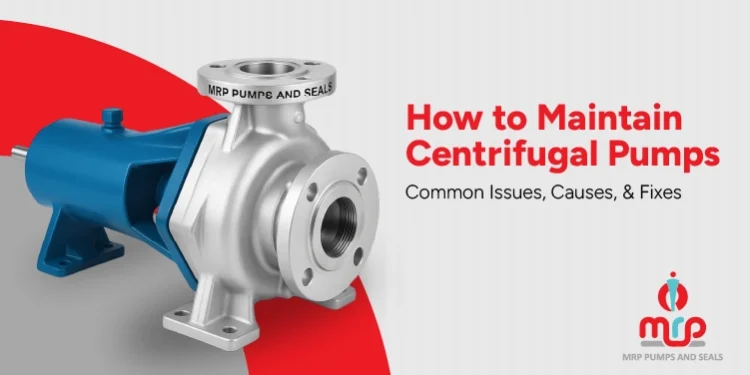
You can’t fix what you don’t know. Here’s what’s inside your centrifugal pump:
Impeller: Rotating disc with vanes that moves fluid. Usually cast iron or stainless steel.
Casing: Stationary housing around the impeller. Shapes flow and builds pressure.
Shaft: Connects motor to impeller. Handles serious torque and bending loads.
Mechanical Seal: Stops leaks where shaft exits casing. Your #1 maintenance headache.
Bearings: Support the shaft. Need proper lubrication or they seize.
Wear Rings: Maintain clearances. Designed to wear before expensive parts get damaged.
Each part matters. When one fails, it often damages others. Early detection saves thousands.
Quick Sound Guide: What’s That Noise?
| Sound | Problem | Action |
| Grinding/scraping | Bearing failure | Stop now |
| Rattling | Cavitation | Check today |
| Squealing | Misalignment | Fix soon |
| Rumbling | Worn bearings | Schedule repair |
Top 10 Centrifugal Pump Problems and Fixes
1. Cavitation: The Gravel Sound Problem
Cavitation sounds like rocks rattling through your pump. Tiny bubbles form and explode against metal. The damage looks like hammer strikes on the impeller.
Why It Happens:
- Insufficient suction pressure (NPSH problems)
- Blocked suction lines or clogged strainers
- Pump installed too high above liquid source
- Running at very low flow rates
How to Fix It:
1.Quick fixes: Clean suction strainers, open any closed suction valves
2. Permanent solution: Lower pump by 1-2 meters, increase suction pipe size
3. Operating fix: Keep flow between 70-120% of Best Efficiency Point
4. Prevention: Install suction pressure monitoring
Pro Tip: Early cavitation shows as light pitting. Catch it early—polishing restores performance. Wait too long and you’re buying new impellers for ₹8,000-₹45,000.
2. Loss of Flow or Pressure
The pump runs but delivers only 60-70% of rated flow. Production suffers.
Common Causes (Ranked):
| Cause | Probability | How to Check |
| Worn wear rings | 40% | Check clearances during shutdown |
| Air ingress | 25% | Look for foam, listen for gurgling |
| Wrong impeller size | 20% | Measure and verify diameter |
| Belt slippage | 10% | Check motor RPM with tachometer |
| Closed valve | 5% | Verify valve position first |
Step-by-Step Fix:
- Check discharge valve—is it fully open?
- Measure actual flow and pressure vs. pump curve
- Inspect for air leaks at seals and flanges
- Verify motor speed (should be within 2% of nameplate)
- Check wear ring clearances during next shutdown
Replace worn parts when clearances exceed 0.60mm. For Centrifugal End Suction Pumps in chemical service, annual inspection is standard.
3. Excessive Vibration
Touch a healthy pump—you feel a gentle hum. Touch one with problems—your whole arm shakes.
Vibration above 4.5mm/s means trouble. It destroys bearings, cracks pipes, and loosens bolts.
Vibration Troubleshooting:
Pulsating at pump speed? → Unbalanced impeller
Different horizontal vs. vertical? → Misalignment
Pump rocks when pushed? → Loose foundation
Changes with flow rate? → Cavitation or air
High-frequency buzz? → Bearing wear
Professional Fix Steps:
- Fix soft foot first (check for gaps under mounting feet)
- Laser align to <0.05mm (dial indicators are obsolete)
- Balance impeller to ISO G2.5 standard
- Torque bolts properly (40-60 Nm typical)
- Recheck after 24 hours of operation
Vertical Inline Centrifugal Pumps need quarterly vibration checks. They’re sensitive to alignment issues.
4. Mechanical Seal Failure
Seals are precision parts doing impossible work. They stop leaks while parts spin at 3,000 RPM with heat and chemicals.
Warning Signs:
Normal: 2-3 drops per minute, no crystals, warm seal area
Warning: 5-10 drops per minute, white deposits, slight squeaking
Critical: Steady stream, heavy buildup, grinding noise, hot bearings
Root Causes and Solutions:
| Problem | Cause | Fix |
| Carbon dust | Dry running | Install run-dry protection |
| Embedded particles | Contamination | Filter flush fluid |
| Uneven wear | Misalignment | Realign pump (<0.05mm) |
| Swollen O-rings | Chemical attack | Use FFKM or PTFE seals |
| Cracked housing | Over-tightening | Follow 5-10 Nm torque spec |
Cost Reality:
Emergency seal replacement: ₹12,000-₹18,000
Planned replacement: ₹5,000-₹8,000
Bearing damage from failed seal: Add ₹8,000-₹35,000
At MRP Pumps, we stock seals for all pumps we supply. Planned replacement saves 60%.
5. Bearing Failure Prevention
Bearings fail from simple, preventable mistakes. Get lubrication right and solve most problems.
Why Bearings Fail:
- 43% – Wrong or insufficient lubrication
- 22% – Contamination (water, dust, particles)
- 16% – Misalignment creating side loads
- 13% – Improper installation or handling
- 6% – Other causes
Lubrication Best Practices:
1. Use only manufacturer-specified grease type
2.Fill bearings 1/3 to 1/2 full (never pack solid)
3. Grease every 2,000-3,000 operating hours
4. Don’t mix different grease types
5. Monitor temperature (<70°C normal, >80°C problematic)
Temperature Guide:
| Reading | Status | Action |
| <70°C | Normal | Keep monitoring |
| 70-80°C | Warm | Check lubrication daily |
| 80-90°C | Hot | Investigate now |
| >90°C | Critical | Shutdown required |
High Pressure Multistage Pumps need both radial and thrust bearings. Thrust bearing failure destroys the entire pump. Quarterly inspection is mandatory.
6. Overheating Problems
If you can’t keep your hand on the pump for 10 seconds, it’s too hot.
Heat above 85°C damages seals and lubricants. For every 10°C over design temperature, seal life drops 50%.
Hot Casing (>70°C):
- Running below minimum flow
- Dead-heading against closed valve
- Worn wear rings causing recirculation
Fix: Install 15-25% minimum flow bypass, never throttle below 40% of rated flow, check wear rings.
Hot Bearings (>80°C):
- Wrong or insufficient lubricant
- Over-greasing causing churning
- Misalignment or bearing wear
Fix: Check oil level (1/3 to 1/2 full), remove excess grease, laser-check alignment, replace worn bearings.
For high-temperature service above 150°C, upgrade to Air Cooled Pumps or Thermal Hot Oil Pumps designed for heat.
7. High Power Consumption
Your pump is drawing 20-30% more current than nameplate. That wastes energy and money.
Energy Waste Sources:
| Cause | Loss | Fix |
| Operating off pump curve | 20-40% | Match flow to design point |
| Worn internals | 15-25% | Replace wear parts |
| Misalignment | 10-15% | Laser aligns properly |
| Wrong rotation | 30-50% | Verify direction |
| High fluid density | Proportional | Normal if fluid changed |
Efficiency Optimization:
- Calculate wire-to-water efficiency (should be 60-75%)
- Plot current operation on pump curve
- Replace parts when clearances exceed 150% of new
- Consider VFD for variable flow (30-50% energy savings)
Close Coupled Centrifugal Pumps show efficiency losses immediately. The motor mounts directly—no cushion for inefficiency.
8. Impeller Damage
The impeller is your pump’s heart. Damage here kills performance fast.
Common Damage Types:
Erosion: Material worn by particles or high velocity. Rounded edges, thinned vanes, polished surfaces.
Corrosion: Chemical attack creating pits, roughness, or holes. Critical in acid/caustic service.
Cavitation: Spongy pitting from bubble collapse. Looks like someone hammered the metal.
Fouling: Scale or polymer buildup blocking passages. Common in cooling water.
Repair or Replace?
| Damage Level | Description | Action | Expected Life |
| Minor | <10% material loss | Polish & rebalance | 80-90% |
| Moderate | 10-30% loss, pits <5mm | Repair coating | 50-70% |
| Severe | >30% loss, deep pits | Replace | 100% |
| Any crack | Crack or hole present | Replace now | Critical |
Inspection Protocol:
- Remove pump cover during shutdown
- Photograph impeller from all angles
- Measure vane thickness at multiple points
- Check for cracks with dye penetrant
- Weigh impeller (deposits add weight)
For Slurry Pumps and abrasive service, erosion is normal. Upgrade to hardened materials for longer life.
Cost Check: Cast iron impeller ₹5,000-₹12,000, Stainless steel ₹15,000-₹35,000, Exotic alloys ₹1,50,000+
9. Misalignment Issues
You can’t see 0.10mm offset. But your pump feels it—and dies from it.
Studies show 50% of seal failures and 30% of bearing failures trace back to misalignment. It’s completely preventable.
Why Alignment Matters:
Perfect alignment: Equipment runs smoothly, parts last full life.
0.10mm off: Seal wears unevenly, bearing loads increase 2-3x.
0.25mm off: Seal fails in months instead of years.
0.50mm+ off: Catastrophic failure likely within weeks.
Alignment Standards:
| Parameter | Acceptable | Excellent |
| Parallel offset | <0.10mm | <0.03mm |
| Angular offset | <0.10mm/100mm | <0.03mm/100mm |
| Soft foot | <0.05mm | <0.02mm |
The 5-Step Fix:
Step 1: Check soft foot (60% of “alignment” problems are actually foundation issues)
Step 2: Use laser alignment tools (dial indicators are obsolete)
Step 3: Move in small steps (0.05mm at a time)
Step 4: Torque all bolts properly in star pattern
Step 5: Recheck after 24-48 hours of operation
Hot Pumps: For fluids above 100°C, align “cold” but offset motor downward. Thermal growth brings it perfect when hot.
Vertical Long Shaft Sump Pumps have different requirements. Shaft straightness matters more than coupling alignment.
10. Priming and Suction Problems
The pump won’t prime or loses suction during operation. Motor runs but no fluid moves.
Won’t Prime Initially:
Causes:
- Suction lift too high (>5-6m for most pumps)
- Suction line not filled with liquid
- Foot valve stuck or check valve jammed
- Wrong rotation direction
Fixes:
- Install Vertical Long Shaft Sump Pumps for deep sumps
- Add vacuum priming system (pump or eductor)
- Use foot valves rated 2x pump size
- Verify clockwise rotation (viewed from motor)
Loses Prime During Operation:
Causes:
- Vortexing in suction tank drawing air
- Insufficient submergence (liquid level low)
- Vapor lock from fluid heating up
- Air pockets in high points of piping
Solutions:
- Maintain minimum 0.5m + one pipe diameter submergence
- Install anti-vortex baffles in tank
- Slope piping continuously upward to pump
- Add air release valves at unavoidable high points
Use Vertical Seal / Gland Less Pumps for better priming
Air Leak Detection:
Apply soapy water to all suction connections. Bubbles reveal leaks.
Check These First:
- Suction flange gasket (replace every 2-3 years)
- Mechanical seal faces
- Any threaded connections
- Pump case o-ring
For Sewage Mud Pumps with solids, open impellers handle air better than closed designs.
Quick Fix: Fill pump casing through discharge port before startup. Creates instant prime while you fix the root problem.
Maintenance Schedule That Works
A structured program prevents 70-80% of failures:
Daily (5-10 minutes):
- Listen for unusual noises
- Check for leaks
- Verify pressure and flow
- Feel bearings for heat
- Check foundation bolts
Weekly (15-20 minutes):
- Record vibration levels
- Check lubricant levels
- Inspect coupling
- Verify motor current
- Clean strainer screens
Monthly (1-2 hours):
- Grease bearings
- Check alignment
- Tighten packing gland
- Inspect strainer
- Test instruments
Quarterly (4-6 hours):
- Full vibration analysis
- Oil sampling and testing
- Thermographic inspection
- Review performance data
- Update records
Annual (1-3 days):
- Complete disassembly
- Replace seals and bearings
- Replace wear rings if needed
- Inspect impeller
- Precision alignment
- Hydrostatic testing
Adjust frequency for your service. Abrasive or chemical service needs 2x more frequent checks.
When to Call Professionals vs. DIY
You Can Handle:
- Greasing bearings (with proper training)
- Checking oil levels
- Tightening packing glands
- Basic cleaning and inspection
- Recording performance data
- Replacing simple gaskets
Call Professionals For:
- Mechanical seal replacement (requires precision)
- Bearing replacement (needs hydraulic pullers, heaters)
- Impeller balancing (requires ₹8-15 lakh machine)
- Laser alignment (<0.05mm accuracy needed)
- Root cause failure analysis
- Performance testing
Cost Comparison:
DIY seal: ₹3,000 parts, fails in 6-12 months, multiple attempts = ₹15,000 over 3 years
Professional: ₹8,000-₹12,000, lasts 3-4 years = Better long-term value
At MRP Pumps, our technical team handles 200+ service calls annually. We maintain detailed history for predictive maintenance.
Real Results: Maintenance Program Impact
A pharmaceutical client had chronic seal failures every 3-4 months on six Polypropylene Centrifugal Pumps. Each failure cost ₹45,000 in downtime plus parts and labor.
Problems Found:
- All pumps misaligned by 0.15-0.35mm
- Wrong seal material for the chemical
- No minimum flow bypass installed
- Zero preventive maintenance
Solutions:
- Laser aligned all pumps at operating temperature
- Installed proper FFKM seals
- Added bypass valves
- Created preventive maintenance schedule
Results After 12 Months:
| Metric | Before | After | Improvement |
| Seal life | 3.8 months | 22 months | 479% |
| Downtime events | 18 | 3 | 83% less |
| Emergency costs | ₹63,000 | ₹8,500 | 87% less |
| Energy use | Baseline | -12% | Lower bills |
| Annual maintenance | ₹3.24 lakhs | ₹82,000 | 75% savings |
Total benefit: ₹7.53 lakhs annually
Investment: ₹1.85 lakhs
Payback: 2.9 months
The real win? Peace of mind. No more midnight emergency calls.
Conclusion: Simple Maintenance, Big Results
Pump maintenance isn’t complicated. But it must be consistent.
The difference between a 3-year pump and a 15-year pump? A maintenance program followed every day, every week, every month.
What Actually Matters:
- Record baselines when pumps are new
- Focus on lubrication and alignment
- Fix small problems immediately
- Document everything
- Train your people
- Know when to call experts
Whether you run High Pressure Triplex Plunger Pumps, Metering Dosing System Pumps, or standard Centrifugal Process Pumps, these principles work universally.
Good maintenance is an investment. It pays back in reliability, efficiency, and lower costs. Give your pumps proper attention and they’ll serve you for decades.
Get expert pump maintenance support from MRP Pumps—15+ years serving Ahmedabad's industrial sector. Contact us or call at +91 98259 69278 Request a pump health audit to find hidden problems before they cause expensive downtime.
Explore our complete range at mrppumps.com—industrial pumps, genuine spares, and maintenance services.
Frequently Asked Questions (FAQs)
Daily visual checks, weekly monitoring, monthly hands-on work, and annual overhauls. Severe applications need more—sometimes quarterly inspections for chemical or abrasive service.
Mechanical seal failure (40-50% of failures), then bearings (20-30%). Root causes are usually misalignment or poor lubrication—both preventable.
Watch for 15% drop in flow/pressure, unusual vibration, visible leaks, bearings over 80°C, increased power draw, or grinding/rattling noises. Any sudden change needs investigation.
Basic work—greasing, monitoring, gasket replacement—yes. Precision work—seals, bearings, balancing, alignment—needs professionals with specialized tools. Most facilities use both.
Budget 8-12% of pump cost. A ₹50,000 pump needs ₹4,000-₹6,000/year. Preventive maintenance costs 75% less than emergency repairs.
Broken impeller, worn wear rings, air ingress, or mechanical damage (sheared coupling). Check for noise and vibration. Shut down immediately to prevent more damage.
15-20 years average with good maintenance. Clean water pumps can exceed 30 years. Chemical/slurry pumps may need replacement in 8-12 years despite care.
Lower pump elevation, enlarge suction pipes, minimize fittings, and operate at 70-120% of Best Efficiency Point. Install pressure monitoring to detect problems early.