


A liquid ring vacuum pump can pass every shop test and still fall short on site. One possible cause is a vacuum target that the selected pump cannot achieve with the service liquid temperature and process conditions actually available.
That is the real question behind single stage vs two stage. It starts with how deep a vacuum your process needs and how much vapor travels with the gas. Price and size come second.
This guide explains the difference, shows where each type fits, and lists the checks to run before you specify one. It is written for plant engineers, maintenance teams and buyers handling distillation, drying, evaporation or condenser duty.
Key Takeaways
- Stage Count Influences Vacuum Performance: A single stage pump compresses gas in one stage. A two stage pump uses two stages in series, which generally makes it better suited to deeper vacuum duty.
- Service Liquid Limits Both: The vapor pressure of the service liquid sets a fundamental lower limit on attainable suction pressure. Warmer service liquid generally reduces the vacuum the pump can reliably achieve.
- Single Stage Often Suits Moderate Vacuum: A single stage pump is commonly selected for moderate-vacuum duties where simpler construction and rugged wet-gas handling are priorities.
- Two Stage Often Suits Deeper Duty: A two stage pump is commonly considered when the process needs deeper vacuum or operates close to the practical limit of a comparable single-stage design.
- Both Handle Wet Gas Well: Both types are well suited to wet and vapor-laden gas and can tolerate liquid carryover better than many dry vacuum technologies. Material compatibility and the amount of liquid or solids still need to be checked.
- Read the Curve, Not the Label: Compare capacity at your operating pressure on the pump curve, not the nominal capacity.
- Water Use Matters: Service water demand and motor size differ by model, so compare them as part of lifecycle cost.
What Is the Difference Between a Single Stage and a Two Stage Liquid Ring Vacuum Pump?
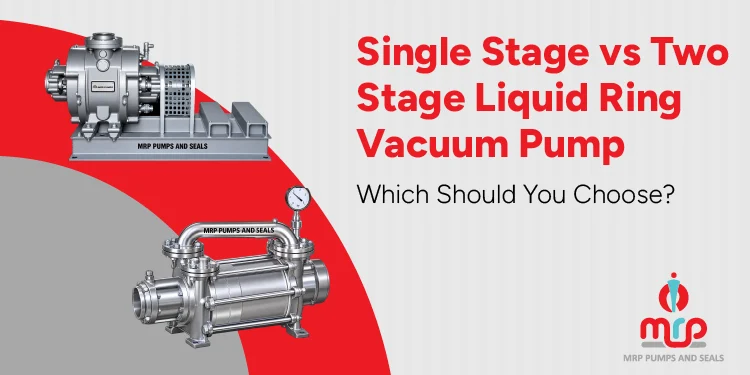
A single stage liquid ring vacuum pump compresses gas in one stage. A two stage pump passes the gas through two compression stages in series, so the overall compression is divided between the stages.
Both types share one principle. An eccentric impeller spins inside a casing partly filled with service liquid, usually water. Centrifugal force forms a liquid ring, and the cavities between the blades expand and shrink to draw in, compress and discharge gas.
The ring also seals internal clearances and absorbs heat of compression. It can condense condensable vapors when process conditions allow. This near-isothermal behavior is one reason liquid ring pumps are widely used in wet service such as distillation, drying and evaporation.
How Deep a Vacuum Can Each Type Reach?
A two stage pump generally provides an advantage at deeper vacuum compared with a comparable single stage design. The exact attainable pressure, however, depends on the pump design, gas load, service liquid and service liquid temperature.
The vapor pressure of the service liquid sets a fundamental lower limit on attainable suction pressure. As inlet pressure approaches this limit, service liquid can begin to vaporize more readily, reducing capacity and increasing the risk of cavitation. In practice, the pump is normally operated with margin above this limit.
There is no universal single-stage or two-stage vacuum limit that applies to every liquid ring pump. Some modern single-stage designs can reach relatively low absolute pressures, while other designs have different limits. Always compare the manufacturer’s performance curve at the specified service-liquid temperature rather than relying on a generic stage-based value.
Higher service-liquid temperature raises vapor pressure and reduces the vacuum the pump can reliably achieve. It can also reduce capacity near the pump’s vacuum limit and increase cavitation risk. Cooling the service liquid can improve performance where the process and pump design allow it.
Need Help Matching Vacuum Level to the Right Pump?
Share your required inlet pressure, gas and vapor load, and service-liquid temperature with our team for application-based vacuum pump selection.
When Should You Choose a Single Stage Liquid Ring Vacuum Pump?
Choose a single stage pump when the required operating pressure falls comfortably within the selected model’s performance range and simpler construction is a priority. Single-stage designs are commonly used for moderate-vacuum service and wet or condensable gas duties.
Typical fits include:
- Filtration and dehydration
- Drying and deodorization, depending on the required operating pressure
- Venting and general evacuation
- Duties where simpler construction and lower initial cost are important
MRP Pumps’ single stage liquid ring vacuum pump (model MRPSLVP) is listed for capacities from 49 to 2080 m3/hr. Materials of construction include graded cast iron, SS 304, SS 316, SS 316L, bronze or combinations. A mechanical seal, corrosion-resistant coatings and an exhaust silencer can be supplied for specific applications.
When Should You Choose a Two Stage Liquid Ring Vacuum Pump?
Choose a two stage pump when the process requires deeper vacuum than a comparable single-stage design can provide efficiently at the required gas load and service-liquid conditions. A two-stage design can also be advantageous when the duty operates steadily at low absolute pressure.
Typical fits include:
- Vacuum distillation and solvent recovery where deeper vacuum is required
- Evaporation at reduced boiling temperature
- Sterilization and deodorization when the required absolute pressure supports a two-stage selection
- Processes that operate steadily at low absolute pressure
A two-stage pump typically has greater mechanical complexity and may have a higher initial cost than a comparable single-stage design. The MRP two stage liquid ring vacuum pump range (MRPTVP series) lists capacities up to 980 m3/hr, with service water demand and recommended motor size for each model. Listed industries include chemical, pharmaceutical, bio-diesel, distillery, oil refining and dairy.
Single Stage vs Two Stage: Side-by-Side Comparison
This table summarizes the practical differences. Final selection should still be based on the pump curve and actual operating conditions.
| Factor | Single Stage | Two Stage |
| Compression | One stage | Two stages in series |
| Typical vacuum duty | Moderate to deeper vacuum, depending on design | Often selected for deeper vacuum duty |
| Performance near deep vacuum | Capacity may fall as inlet pressure approaches the model limit | Can offer better performance at low inlet pressure, depending on design |
| Wet gas and vapor | Handled well when compatible with pump materials and service liquid | Handled well when compatible with pump materials and service liquid |
| Construction | Simpler | More complex, two-stage arrangement |
| Initial cost | Often lower for comparable duty | May be higher for comparable duty |
| Typical application examples | Filtration, dehydration, venting, general evacuation | Deep-vacuum distillation, solvent recovery, low-pressure evaporation |
How Do You Choose Between Them? Five Checks
Run these checks in order before you specify a pump:
1. Set the lowest pressure needed. Define it in mbar(a) or another absolute-pressure unit, not only percent vacuum.
2. Estimate the gas load. Include non-condensable gas, vapor load and expected air in-leakage at the operating pressure.
3. Confirm service liquid temperature. Use the highest expected operating temperature, not only the average.
4. Read the pump curve. Compare capacity at your inlet pressure and service-liquid condition, not the nominal capacity.
5. Match materials and sealing. Check both the process gas and service liquid against the casing, impeller, seal and other wetted materials.
Single Stage or Two Stage?
Send your operating pressure, gas load, service-liquid temperature, and process details so our team can help compare suitable single-stage and two-stage options.
Which Applications Suit Which Pump?
| Application | Typical Vacuum Need | Selection Direction |
| Filtration, dehydration, venting | Often moderate | Often single stage, but verify the required pressure and gas load |
| Drying, general evacuation | Moderate to deep | Duty dependent; check both pump curves |
| Vacuum distillation, solvent recovery | Often deep | Often two stage when deeper vacuum is required |
| Evaporation in sugar, paper, chemical or distillery plants | Moderate to deep | Check both; operating pressure and vapor load decide |
| Sterilization, deodorization | Moderate to deep | Check both; the required absolute pressure decides |
What Mistakes Should You Avoid?
- Sizing on nominal capacity. Capacity changes with inlet pressure, gas conditions and service-liquid temperature.
- Ignoring the highest service-water temperature. Higher service-liquid temperature can reduce achievable vacuum and capacity near the pump’s limit.
- Assuming stage count determines gas compatibility. Compatibility depends mainly on the process gas, service liquid and wetted materials, not simply on the number of stages.
- Ignoring uncontrolled liquid carryover or solids. Liquid ring pumps tolerate wet gas well, but large or uncontrolled liquid slugs, solids or incompatible contaminants should be assessed. A separator or knockout vessel may be required for some systems.
Leaving spares to chance. Plan wear parts early. MRP Pumps supplies pump spares across its range.
Conclusion
Choose a single stage liquid ring vacuum pump when the required operating pressure falls comfortably within the selected model’s performance range and simpler construction is preferred. Consider a two stage pump when the process requires deeper vacuum or sustained operation at low absolute pressure. In both cases, check the manufacturer’s pump curve, gas load, service-liquid temperature and material compatibility before selection.
MRP Pumps builds both types in Kathwada, Ahmedabad. To discuss your duty, write to mrppumps@gmail.com or call +91 98259 69278, or browse our full range of industrial pumps.
Planning a Liquid Ring Vacuum Pump Application?
Share your process duty, required vacuum, capacity, gas composition, and service-liquid conditions for a technical review and pump recommendation.
Frequently Asked Questions
1. Can a two stage pump replace a single stage pump?
It can, provided the selected model meets the required capacity at the operating pressure and is suitable for the process conditions. A two-stage design should not be selected solely because it can reach deeper vacuum; compare performance, utilities, cost and maintenance for the actual duty.
2. Is a water ring vacuum pump the same as a liquid ring vacuum pump?
Water ring is a common term for a liquid ring vacuum pump when water is used as the service liquid. Other compatible service liquids may also be used when the process requires them.
3. What limits the ultimate vacuum of a liquid ring pump?
The vapor pressure of the service liquid at its operating temperature is a major limit on attainable suction pressure. Pump design, gas load, operating curve and cavitation margin also affect the practical limit, so a cooler service liquid generally helps but does not determine performance by itself.
4. Can liquid ring vacuum pumps handle wet or condensable gases?
Yes. Liquid ring vacuum pumps are well suited to wet and condensable gases and generally tolerate liquid carryover better than many dry vacuum technologies. Where large or uncontrolled liquid slugs or solids are possible, check the manufacturer’s allowable carryover and consider a separator or knockout vessel if required.
5. How do I size a liquid ring vacuum pump?
Start with the required operating pressure, gas and vapor load, air in-leakage and service-liquid temperature. Then use the manufacturer’s performance curve to confirm capacity at that pressure and operating condition.
6. Which materials suit corrosive gases?
MRP Pumps lists graded cast iron, SS 304, SS 316, SS 316L and bronze for its liquid ring range. The right choice depends on gas composition, condensate and service liquid, so material compatibility should be reviewed for the complete process stream.
7. Is there a liquid ring vacuum pump manufacturer in Ahmedabad?
Yes. MRP Pumps manufactures single stage and two stage liquid ring vacuum pumps in Kathwada, Ahmedabad.