


Mud, sludge, and abrasive slurry show up in almost every heavy industry – sugar mills, mining sites, paper plants, and wastewater treatment plants all generate some form of it. Standard pumps aren’t built for this. Their narrow impellers clog fast, wear out quickly, and lead to unplanned downtime.
Mud pumps solve this by using wider flow passages and tougher materials designed specifically for thick, solid-laden fluids. But not all mud pumps are the same – a sewage mud pump, a slurry pump, and a progressive cavity screw pump each suit different fluid types and industries.
This guide covers the main types of mud pumps, where each one works best, and how to choose the right pump for your process conditions. It also includes a maintenance checklist to help extend pump life once installed.
Key Takeaways
- A mud pump moves thick, abrasive, or solid-laden fluids that standard pumps can’t handle.
- Common types include sewage mud pumps, slurry pumps, and submersible trash pumps.
- Industries like mining, sugar, paper, and wastewater treatment rely on them daily.
- The right mud pump reduces clogging, cuts downtime, and lowers maintenance costs.
- Impeller design and solid handling capacity matter more than raw horsepower.
- A simple weekly inspection routine prevents most mud pump failures.
What Is a Mud Pump?
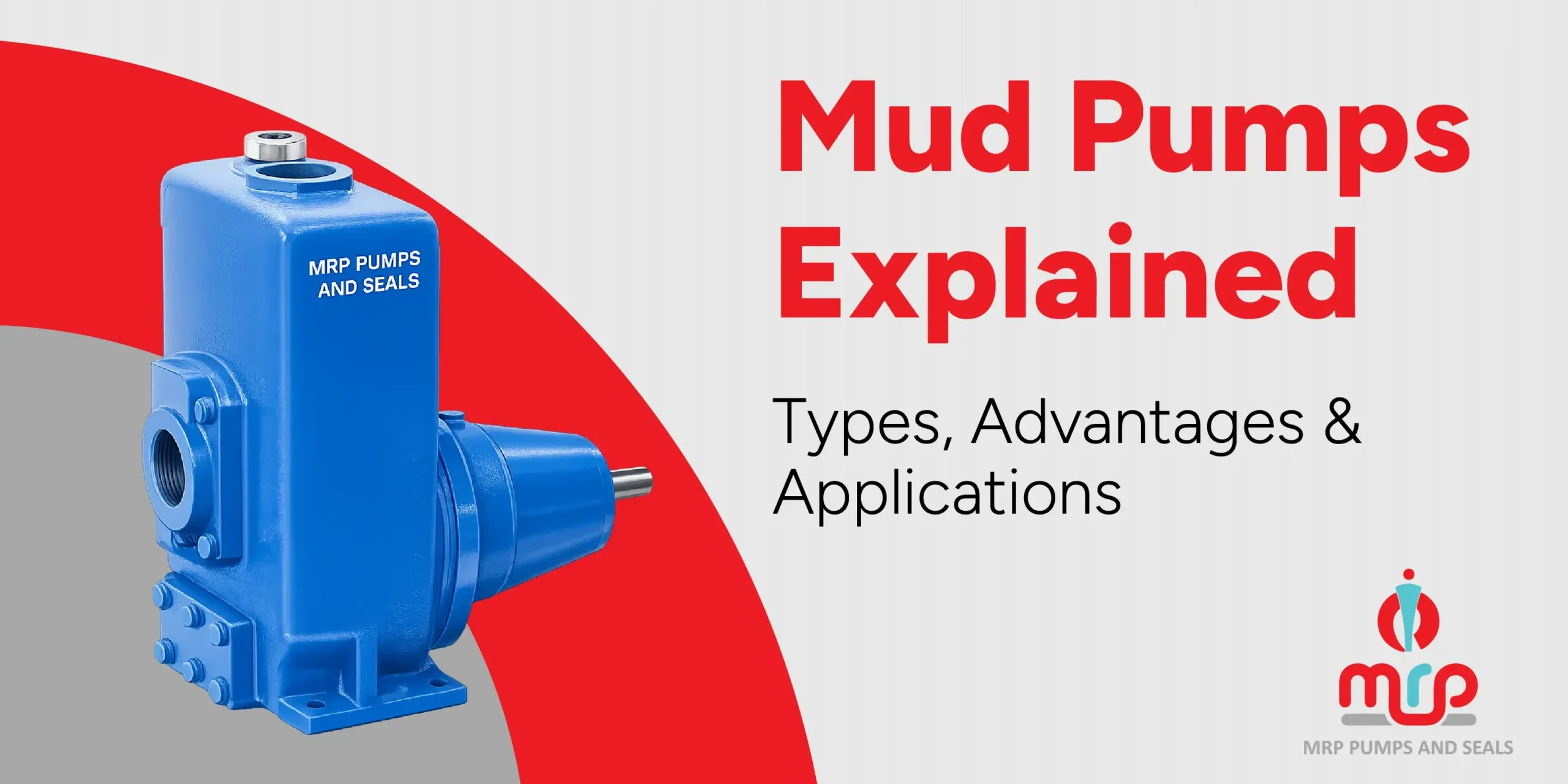
A mud pump is a specialised industrial pump built to move mud, slurry, sludge, or other fluids containing solid particles. Unlike standard water pumps, mud pumps use wider flow passages and tougher wear parts to avoid clogging.
They are essential wherever a process generates thick, gritty, or semi-solid waste. Think drilling sites, sugar mills, paper plants, mines, and municipal wastewater systems.
As an industrial process pumps and seals manufacturer in Ahmedabad, MRP Pumps builds several mud-handling variants, including sewage mud pumps and slurry pumps, for exactly these conditions.
Why Do Standard Pumps Fail with Mud and Slurry?
Standard centrifugal pumps use narrow impeller passages designed for clean liquids. Mud, sand, and fibrous waste jam these passages quickly.
- Abrasion wears impellers and casings faster than clean-water use.
- Clogging from large particles stops flowing and strains the motor.
- Cavitation risk rises when thick fluids create uneven suction pressure.
A pump built for mud avoids these problems through open or semi-open impeller designs and reinforced wear surfaces.
What Are the Main Types of Mud Pumps?
1. Sewage Mud Pumps
Sewage mud pumps handle wastewater loaded with solids, grit, and fibrous material. They use large, open impellers, so debris passes through without jamming.
These pumps commonly work in municipal treatment plants, food processing units, and sugar mills where process water carries organic sludge.
2. Slurry Pumps
Slurry pumps move abrasive mixtures of liquid and solid particles, such as mining tailings or mineral slurries. They’re built with thicker, wear-resistant linings to survive constant particle impact.
Mining, mineral processing, and coal washing operations depend on slurry pumps for continuous, heavy-duty service.
3. Submersible and Trash Pumps
Submersible mud pumps sit directly in the fluid, which reduces suction lift problems in sumps and pits. They suit construction sites, dewatering pits, and flood control applications.
4. Progressive Cavity Screw Pumps
For thick, viscous, or high-solid-content mud, a progressive cavity screw pump provides steady, low-pulsation flow. This design works well for sludge transfer in paper and pulp plants.
5. Multi-Purpose Rotary Gear Pumps
Rotary gear pumps handle viscous, non-abrasive mud-like fluids at controlled flow rates. They’re often chosen for dosing or metering applications rather than bulk transfer.
Mud Pump Types Compared
Pump Type | Best For | Solids Handling | Typical Industry |
Sewage Mud Pump | Wastewater, sludge | High (soft solids) | Municipal, food processing |
Slurry Pump | Abrasive mineral slurries | Very high (hard particles) | Mining, sugar |
Submersible Trash Pump | Pit and sump dewatering | Medium to high | Construction, flood control |
Progressive Cavity Screw Pump | Thick, viscous mud | High (viscous) | Paper & pulp, chemical |
Rotary Gear Pump | Viscous, low-solid fluids | Low to medium | Dosing, chemical transfer |
What Advantages Do Mud Pumps Offer?
- Reduced clogging through open impeller and wide passage design.
- Longer service life from wear-resistant materials like hardened alloys.
- Lower downtime because fewer blockages mean fewer emergency stops.
- Better energy efficiency when matched correctly to flow and head requirements.
- Flexible installation with both submersible and horizontal configurations available.
Where Are Mud Pumps Used Across Industries?
1. Sugar and Agro Processing
Sugar mills generate mud-like waste from juice clarification. Sewage mud pumps and slurry pumps move this efficiently without frequent clogging.
2. Paper and Pulp
Fibrous sludge and pulp residue need pumps that won’t tangle or block. Progressive cavity screw pumps handle this consistently.
3. Mining and Mineral Processing
Slurry pumps transport abrasive tailings and mineral-water mixtures across long distances, often under continuous 24/7 operation.
4. Chemical and Petrochemical
Some process residues behave like mud. High pressure multistage pumps or centrifugal end suction pumps handle these depending on viscosity and pressure needs.
5. Construction and Dewatering
Submersible trash pumps clear excavation pits and flooded work areas, keeping sites operational during monsoon season.
6. Textile and Plywood Processing
Dye sludge and process water residues from textile and plywood units require corrosion- and clog-resistant pumping, often paired with a vertical long shaft sump pump for pit applications.
How Do You Choose the Right Mud Pump?
Selecting the correct pump depends on more than the flow rate. Consider these factors together.
- Particle size and concentration – larger or denser solids need wider impeller clearance.
- Fluid viscosity – thick sludge may need a screw pump instead of centrifugal design.
- Abrasiveness – highly abrasive slurry needs hardened wear parts.
- Installation type – submersible for pits, horizontal for surface-level transfer.
- Duty cycle – continuous operation demands more robust bearing and seal design.
Getting this match right the first time avoids costly re-selection later. Please consult with our team to match pump specifications to your process conditions. Contact us now!
Mud Pump Maintenance Checklist
Regular checks prevent most mud pump failures before they become costly repairs.
- Inspect impeller and wear plate for erosion monthly.
- Check seal and gland condition for leaks weekly.
- Monitor motor temperature and vibration during operation.
- Flush pump casing after handling high-solid loads.
- Verify bearing lubrication on the manufacturer’s schedule.
- Test suction and discharge pressure against baseline readings.
What Safety Standards Apply to Mud Pump Selection?
Industrial pump selection in India commonly references ISO 2858-dimensional standards for centrifugal pump interchangeability. For hazardous or high-temperature fluid environments, ATEX compliance may also apply.
Food-grade applications, such as sugar or agro processing, should check pumps against FSSAI-relevant hygiene requirements where product contact is involved.
Explore our sewage mud pump and slurry pump range to find the right fit for your application. Contact us now!
Why Choose MRP Pumps for Your Mud Pump Requirements?
MRP Pumps manufactures sewage mud pumps, slurry pumps, and progressive cavity screw pumps built for Indian industrial conditions – from sugar mills to mining sites.
- Pump designs suited to high-abrasion, high-solid environments.
- Technical consultation to match pump type with your specific fluid and duty cycle.
- Spare parts and maintenance support to reduce downtime.
- Manufacturing based in Ahmedabad, with experience across chemical, textile, sugar, and mining sectors.
Conclusion
Choosing the right mud pump comes down to matching particle size, viscosity, and duty cycle to the correct pump design – not just picking the highest-horsepower option. Sewage mud pumps, slurry pumps, and progressive cavity screw pumps each solve a different version of the same problem: moving thick, solid-laden fluid without constant clogging.
With the right selection and a regular maintenance routine, mud pumps run reliably for years even in abrasive, high-solid conditions.
Frequently Asked Questions
1. What’s the difference between a mud pump and a slurry pump?
A mud pump is a general term for pumps handling thick, solid-laden fluid. A slurry pump is a specific type built for abrasive mineral or mining slurries.
2. Can a centrifugal pump handle mud?
Only if it is designed with open or semi-open impellers and wide passages. Standard clean-water centrifugal pumps clog quickly with mud.
3. How often should mud pump seals be checked?
Weekly visual checks are recommended, with a full seal inspection during scheduled maintenance to prevent leaks in abrasive service.
4. What causes premature mud pump wear?
Abrasive particle content, incorrect impeller clearance, and running the pump outside its rated flow range all accelerate wear.
5. Are submersible mud pumps better than surface pumps?
Submersible pumps suit pits and sumps with limited suction lift. Surface pumps suit continuous, high-volume transfer where accessibility matters for maintenance.
6. Do mud pumps need special motor protection?
Yes. Continuous solids exposure raises load variation, so thermal overload protection and vibration monitoring are commonly recommended.
7. What industries use the most sewage mud pumps?
Municipal wastewater treatment, sugar processing, food manufacturing, and paper mills are the most frequent users of sewage mud pumps.
8. Can one pump handle both clean water and mud?
Not efficient. Mud-rated pumps trade some clean-water efficiency for solids tolerance, so dedicated pumps per application perform better long-term.