


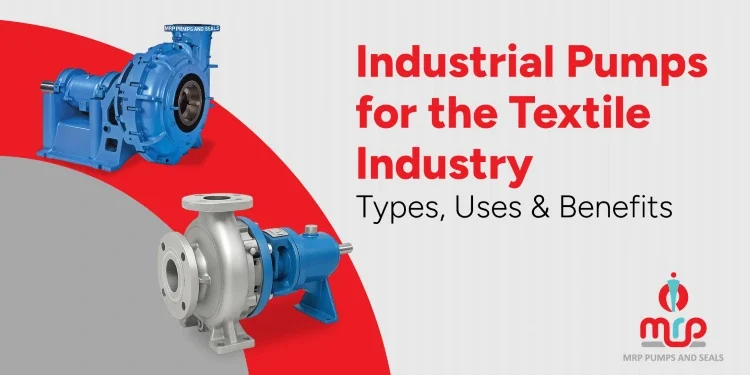
Industrial pumps move fluids through every stage of textile manufacturing – from dyeing and chemical dosing to heat transfer and effluent treatment.
Textile plants handle a wide range of liquids. These include water, dye solutions, corrosive chemicals, hot thermic fluid, printing pastes, and wastewater. Each fluid requires a specific pump type to handle it safely and efficiently.
Choosing the wrong pump leads to leaks, downtime, fabric defects, and high energy costs. MRP Pumps and Seals, an industrial process pumps & seals manufacturer in Ahmedabad, supplies the full range of pump solutions built for the specific demands of textile manufacturing.
This guide covers the key pump types used in textile manufacturing, their applications at each process stage, and how to select the right pump for your plant.
Key Takeaways
- Textile plants rely on pumps across dyeing, washing, finishing, chemical dosing, and effluent treatment.
- The right pump type depends on the fluid – corrosive dyes need polypropylene pumps; viscous pastes need progressive cavity pumps.
- High temperatures in thermic fluid systems demand air cooled or thermal hot oil pumps.
- Effluent treatment lines use slurry pumps, sewage mud pumps, and liquid ring vacuum pumps.
- Wrong pump selection causes frequent downtime, chemical leaks, and wasted energy.
- MRP Pumps, an industrial process pumps & seals manufacturer in Ahmedabad, supplies pump solutions built for India’s textile sector.
Understanding Industrial Pumps for the Textile Industry
Industrial pumps are mechanical devices that move fluids from one point to another by converting motor energy into hydraulic flow. In textile manufacturing, they keep every stage of production running – from dyeing and chemical dosing to heat transfer and effluent treatment.
Textile plants rely on pumps to:
- Circulate dye baths and rinse water through dyeing machines
- Transfer hot oil through thermic fluid heating systems
- Dose chemicals accurately into process baths
- Move sludge and wastewater through effluent treatment plants
Without the right pump at each stage, production slows, fabric quality drops, and operating costs rise. Choosing the correct pump type – matched to the fluid, temperature, and flow requirement – is what keeps a textile plant running efficiently and within compliance.
What Types of Fluids Do Textile Plants Handle?
Understanding fluid characteristics is the starting point for any pump specification. Textile plants process a wide variety of liquids – each with different viscosity, temperature, chemical aggressiveness, and solids content.
Common process fluids in textile manufacturing:
- Process water – soft, hot, or chilled; used across dyeing, washing, and finishing
- Dye solutions and chemical auxiliaries – acidic, alkaline, or oxidising; require corrosion-resistant pump materials
- Thermic fluid (hot oil) – circulates at 200-320°C; requires high-temperature rated pumps
- Printing pastes and sizing agents – thick, viscous fluids unsuitable for standard centrifugal pumps
- Effluent and sludge – carries fibre fragments, dye residues, and chemical solids; requires abrasion-tolerant equipment
Each fluid zone in a textile plant represents a distinct pumping environment. Matching pump technology to fluid type is the first decision that determines long-term reliability.
Centrifugal Pumps in Textile Dyeing and Processing
Centrifugal pumps are the most widely used pump type in textile manufacturing. They use a rotating impeller to convert motor energy into flow, delivering high volumes at moderate pressure – ideal for dyeing bath circulation, rinse water supply, and softening agent distribution.
Centrifugal pump types and their textile applications:
Pump Type | Application | Key Advantage |
|
| High flow, easy back-pull-out maintenance |
Vertical Inline Centrifugal Pump | Space-constrained pipe networks | Inline fit, no extra floor space needed |
Close Coupled Centrifugal Pump | Compact process stations | Fewer alignment issues, smaller footprint |
Horizontal Single Stage Side Suction Pump | High-volume water supply lines | Stable at high flow rates |
Centrifugal Monoblock Pump | General water and utility transfer | Integrated motor-pump, low running cost |
Polypropylene Centrifugal Pump | Corrosive dye and bleaching chemical lines | Chemically inert, long service life |
For plants handling aggressive dye chemicals – acid dyes, reactive dyes, or sodium hypochlorite – polypropylene corrosion-resistant centrifugal pumps are the correct specification. Standard cast iron pumps degrade rapidly in these environments, leading to contamination and premature failure.
For viscous fluids like printing paste, starch sizing, or guar gum thickeners, progressive cavity screw pumps are the right choice. They move high-viscosity, shear-sensitive fluids smoothly and without pulsation – something standard centrifugal pumps cannot achieve.
Pumps for Thermic Fluid Heating Systems
Most textile plants use thermic fluid heaters to supply heat to stenters, calenders, and dryers. Hot oil circulates at 200-320°C through a closed loop, transferring heat without the pressure hazards of high-temperature steam.
The pump in this loop runs continuously under severe thermal conditions. Standard pumps fail quickly – seals degrade, bearings overheat, and fluid leaks create fire risks.
Thermal hot oil pumps are purpose-built for this service. They feature:
- High-temperature mechanical seals rated for sustained service above 300°C
- Heat-resistant bearing assemblies with extended lubrication intervals
- Metallurgy selected to resist degradation at continuous operating temperatures
Where cooling water is unavailable – rooftop plant rooms or remote heater stations – air cooled pumps offer an effective alternative. An integrated air-cooling system maintains safe seal face temperatures without requiring a water connection, reducing installation complexity and operating cost.
MRP Pumps supplies both thermal hot oil and air-cooled pump variants, built to the specifications required by India’s textile heating applications.
Chemical Dosing and Metering Pumps in Textiles
Accurate chemical dosing directly determines fabric quality and colour consistency. Too little auxiliary chemical causes process failure. Too much increases cost and adds load to the effluent plant.
Where dosing pumps are used in textile plants:
- Dye bath preparation and colour kitchen lines
- Pre-treatment chemical addition – scouring, desizing, bleaching
- Finishing agent dosing – softeners, optical brighteners, fixing agents
- ETP chemical feed – coagulants, flocculants, pH correction chemicals
Metering plunger pumps are the standard for high-precision dosing. They deliver a controlled volume per stroke with ±1% flow accuracy, regardless of back pressure variation. This level of precision is essential in dye bath preparation, where small concentration deviations cause visible shade differences across fabric batches.
For handling concentrated acids, alkalis, or oxidizing agents, metering dosing system plungers and diaphragm pumps provide added safety. The diaphragm separates the process of fluid from the pump’s mechanical parts – eliminating leakage through shaft seals and reducing chemical exposure risk for plant operators.
Pumps for Textile Effluent Treatment Plants
Every textile wet processing plant generates effluent – coloured wastewater containing residual dyes, surfactants, fibres, and chemical sludge. ETPs are a regulatory requirement across India, and the pump systems supporting them are among the most demanding in the facility.
Pump types used across ETP stages:
- Sewage mud pumps – move raw effluent from collection sumps into primary treatment tanks; non-clog impeller design handles fibres and solid fragments
- Slurry pumps – transfer sludge from sedimentation tanks to filter presses; abrasion-resistant impellers handle grit and particulate load
- Vertical long shaft sump pumps – install directly inside collection pits; eliminate suction lift problems and the need for a separate pump room
- Single stage and two stage liquid ring vacuum pumps – maintain vacuum in filtration systems during sludge dewatering, reducing filter cake moisture content
- Vertical seal / gland less pumps – used in chemical dosing circuits where zero leakage is required; no mechanical seal means no drip risk
A well-specified ETP pump set reduces treatment cycle time, lowers chemical consumption, and keeps discharged within Central Pollution Control Board (CPCB) compliance limits.
High-Pressure Pumps in Textile Facilities
High-pressure pump requirements exist in specific areas that are often underspecified during initial plant design.
Machinery cleaning is one of the most significant. Dye residues, sizing deposits, and chemical buildups accumulate dyeing machines, rollers, and fabric guides between production cycles. High pressure triplex plunger pumps deliver sustained, consistent pressure for effective hydro-jet cleaning without surface damage.
Hot water supply to jet dyeing machines and high-temperature processing equipment requires pressure beyond the capability of single-stage centrifugal pumps. High pressure multistage pumps build pressure across multiple impeller stages, achieving the required operating head without cavitation.
During plant maintenance, motorized hydraulic test pumps pressure-test pipelines, steam lines, and vessel connections after repairs – a mandatory safety step before recommissioning any pressurized system in a textile facility.
How to Select the Right Pump for a Textile Application
Use this three-step framework before specifying any pump for your textile plant:
Step 1 – Evaluate the fluid:
- Is it corrosive? → Specify polypropylene or stainless-steel construction
- Is it viscous (>500 cP)? → Use progressive cavity or positive displacement technology
- Does it carry solids or fibres? → Use slurry pump or non-clog sewage pump
- Is hot oil above 150°C? → Use thermal hot oil or air-cooled pump
Step 2 – Define the hydraulic requirements:
- Required flow rate (m³/hr)
- Total dynamic head – static lift + pipe friction + system pressure (metres)
- Select a pump that operates at or near its Best Efficiency Point (BEP) at design conditions
Step 3 – Assess the installation:
- Limited floor space → vertical inline or close coupled pump
- Sump or pit location → vertical long shaft sump pump
- No cooling water available → air cooled pump
- Hazardous area → explosion-proof motor and seal arrangement
Completing this evaluation before purchasing prevents costly pump mismatches and avoids premature failure in service.
Pump Maintenance Checklist for Textile Plants
A structured preventive maintenance programmed significantly reduces unplanned pump failures and extends service life across all pump types.
Weekly:
- Check for seal leakage on centrifugal pumps in dye chemical service
- Inspect suction strainers on slurry and sewage pumps for blockage
- Verify metering pump stroke rate against expected dosing volumes
Monthly:
- Check bearing temperatures on thermal hot oil and air-cooled pumps
- Flush slurry pump internals to prevent solids from hardening in the casing
- Inspect polypropylene pump bodies for signs of chemical attack or cracking
Quarterly:
- Calibrate metering and dosing pumps against known volume references
- Verify liquid ring vacuum pump operating vacuum level against specification
- Check mechanical seal faces on high-temperature pumps for wear or scoring
Annually:
- Full disassembly inspection on all centrifugal pumps in continuous service
- Measure impeller clearances and shaft run out; replace seals preventively
- Review pump operating logs for flow rate reduction or power increase trends
Maintaining a pump log – recording operating hours, maintenance actions, and performance readings – enables data-driven scheduling and reduces reactive repair costs over the plant’s lifetime.
Why Choose MRP Pumps for Your Textile Plant?
MRP Pumps is an industrial process pumps & seals manufacturer based in Ahmedabad – one of India’s largest industrial hubs. We supply pump solutions built specifically for the demanding conditions of textile manufacturing.
Here is what sets us apart:
- 15+ years of experience serving chemical, textile, and process industries across India
- Wide product range – from centrifugal and thermic fluid pumps to dosing systems and ETP pump sets
- Custom pump solutions matched to your fluid type, temperature, and flow requirements
- Pump spare parts and components readily available to minimize downtime
- Technical consultation and system optimization support at every stage – selection, installation, and maintenance
Whether you need a single replacement pump or a complete pump system for a new textile line, our team provides the right solution for your application.
Conclusion
Textile manufacturing runs on pumps. Every stage – from dyeing and heat transfer to chemical dosing and effluent treatment – depends on the right pump working reliably. A wrong pump selection does not just cause mechanical failure. It affects fabric quality, increases energy costs, and creates compliance risks.
Understanding your fluid, your flow requirements, and your installation constraints is the foundation of correct pump selection. And having a reliable pump manufacturer behind you ensures that support continues long after installation.
Speak to our technical team about pump selection for your textile plant.
Frequently Asked Questions
1. What is the most used pump in textile dyeing sections?
Centrifugal end suction pumps are the most widely used. They circulate dye baths, rinse water, and auxiliaries at the high flow rates required by jet dyeing machines and jiggers.
2. Which pump material is best for handling dye chemicals?
Polypropylene is the preferred material. It resists attack from acid dyes, reactive dyes, bleaching agents, and optical brighteners – providing far longer service life than standard cast iron.
3. What pump is used in thermic fluid heater circuits?
Thermal hot oil pumps are used for thermic fluid circuits. They are rated for continuous service at up to 320°C. Air cooled variants are used where cooling water supply is unavailable.
4. How do metering pumps improve textile process quality?
Metering plunger pumps deliver chemical doses within ±1% flow accuracy. This ensures consistent bath concentrations across every batch, directly reducing shade variation and fabric rejection.
5. What pumps are required in a textile ETP?
Textile ETPs need sewage mud pumps for raw intake, slurry pumps for sludge transfer, vertical sump pumps for pit installations, liquid ring vacuum pumps for filtration, and gland less pumps for chemical dosing.
6. Can centrifugal pumps handle textile printing paste?
No. Printing paste viscosity is far beyond the effective range of centrifugal pumps. Progressive cavity screw pumps are the correct choice for moving thick, shear-sensitive fluids without pulsation.
7. What is the role of high-pressure multistage pumps in textiles?
They supply pressurized hot water to jet dyeing machines operating at elevated temperatures. Multi-stage impeller configuration builds pressure gradually, preventing cavitation and maintaining consistent flow.
8. How often should textile plant pumps be serviced?
Pumps in aggressive chemical or sludge service should be inspected monthly. Thermal oil pumps need quarterly bearing checks. Full overhauls are recommended annually for all pumps in continuous service.