


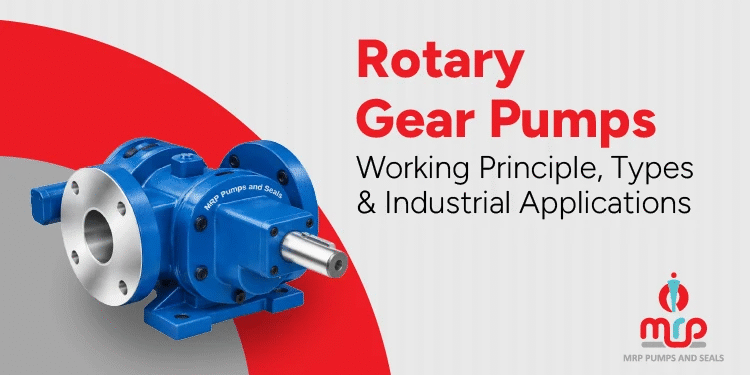
A rotary gear pump is a positive displacement (PD) pump that moves fluid by repeatedly enclosing a fixed volume using interlocking cogs or gears. By transferring liquid mechanically through a “gear-within-a-gear” or meshing tooth system, these pumps provide a constant flow that remains steady regardless of changes in system pressure.
Choosing a Multi-Purpose Rotary Gear Pump is the most effective way to handle high-viscosity liquids like oils, resins, and syrups that would stall a standard Centrifugal Pump. As a leading Industrial Process Pumps & Seals Manufacturer in Ahmedabad, MRP Pumps and Seals engineers these solutions to withstand the most demanding industrial environments.
Key Takeaways
- Positive Displacement: A Multi-Purpose Rotary Gear Pump delivers a constant volume of fluid regardless of pressure changes.
- Viscosity Specialist: These pumps are the optimal choice for oils, syrups, and resins where a Centrifugal Pump would fail.
- High-Pressure Capability: Capable of reaching pressures up to 50 bar, making them ideal for heavy industrial transfer.
- Durable Construction: Precision-engineered gears and casings reduce long-term maintenance costs and improve reliability.
- Versatile Application: Widely used in the oil, chemical, textile, and paper industries throughout the Ahmedabad industrial hub.
- Local Expertise: Partnering with a dedicated Industrial Process Pumps & Seals Manufacturer in Ahmedabad ensures rapid access to Pump Spares and technical support.
What is the Working Principle of a Rotary Gear Pump?
The working principle of a rotary gear pump involves the use of rotating gears which mesh to create a vacuum at the pump inlet. This vacuum draws the fluid into the spaces between the gear teeth. As the gears rotate, the fluid is trapped and carried around the outer casing from the suction side to the discharge side.
Unlike a Centrifugal End Suction Pump which uses velocity to move fluid, a rotary gear pump uses mechanical force to “push” the liquid out. The mesh of the gears on the discharge side displaces the fluid, forcing it into the outlet pipe. Because the volume per revolution is fixed, the pump delivers a steady, pulse-free flow.
Key Components of a Rotary Gear Pump:
- Driving Gear: The primary gear connected to the motor shaft that initiates rotation.
- Idler Gear: The secondary gear that meshes with the driver to move the fluid.
- Pump Casing: The outer housing that seals the gears and creates the flow path.
- Shaft and Bearings: Precision components that support high-pressure rotation.
- Seals: Critical for preventing leaks, often involving specialized mechanical seals.
What are the Main Types of Rotary Gear Pumps?
Rotary gear pumps are generally classified into two main types: Internal Gear Pumps and External Gear Pumps. Each type is designed to handle specific viscosities and pressure requirements across industrial sectors.
1. External Gear Pumps
External gear pumps consist of two identical gears rotating against each other. They are commonly used for high-pressure applications such as hydraulic power units or chemical dosing. These pumps are valued for their simplicity and ease of maintenance.
2. Internal Gear Pumps
Internal gear pumps use a “gear-within-a-gear” design, often with a crescent-shaped internal seal. These are ideal for highly viscous liquids and shear-sensitive fluids. They provide excellent suction capabilities and are frequently found in food processing and oil refineries.
How Does a Rotary Gear Pump Compare to Other Pump Types?
Selecting the right pump depends on the fluid’s viscosity and the required discharge pressure. While a Centrifugal Pump is excellent for water-like fluids, a Multi-Purpose Rotary Gear Pump is superior for thick substances.
Comparison: Rotary Gear Pumps vs. Centrifugal Pumps
Feature | Multi-Purpose Rotary Gear Pump | Centrifugal End Suction Pump |
Flow Type | Constant, Positive Displacement | Variable based on pressure |
Viscosity | High (Oils, Resins, Molasses) | Low (Water, Solvents) |
Pressure | High (up to 50 bar) | Moderate |
Self-Priming | Excellent | Generally, requires priming |
Typical Use | Oil & Gas, Chemicals | Water Treatment, General Industrial |
Which Industries Use Rotary Gear Pumps?
As a prominent Industrial Process Pumps & Seals Manufacturer in Ahmedabad, MRP Pumps and Seals serves diverse sectors that rely on the precision of gear technology.
1. Oil and Petrochemical
Rotary Gear pumps are essential for transferring crude oil, lubricants, and bitumen. Their ability to handle high pressures makes them a staple in refineries alongside the Hot Oil Thermal Transfer Pump and Air-Cooled Pump.
2. Chemical and Fertilizer Plants
Moving aggressive chemicals requires materials like a Polypropylene Corrosion Resistant Centrifugal Pump for low viscosity, but rotary gear pumps are used for high-viscosity chemical additives. They ensure precise flow rates for consistent batch processing.
3. Textile and Paper Industries
In textile manufacturing, Rotary gear pumps move dyes and finishing agents. Paper mills often pair them with a Liquid Ring Vacuum Pump or a Two Stage Liquid Ring Vacuum Pump to manage different stages of the production line.
4. Food, Sugar, and Agro-Industries
The sugar and agro-industries use gear pumps to move molasses and syrups. For viscous fluids containing solids, a Progressive Cavity Screw Pump or Slurry Pump may be used as alternatives.
Explore our range of Multi-Purpose Rotary Gear Pumps
Contact MRP Pumps today for a technical consultation or a customized quote.
How to Select the Right Rotary Gear Pump?
Selection is based on the fluid’s “Duty Point,” which involves calculating flow rate, viscosity, and system resistance.
1. Viscosity Rating: High-viscosity fluids require slower rotational speeds to prevent cavitation.
2. Pressure Requirements: For extreme pressure needs (up to 50 bar), a Multi-Purpose Rotary Gear Pump is highly effective. For testing these systems, a Motorized Hydraulic Test Pump is often used.
3. Material Compatibility: Ensure the pump casing and gears are compatible with the fluid to prevent wear. Corrosive fluids may require a Polypropylene Corrosion Resistant Centrifugal Pump if viscosity is low.
4. Flow Control: If precise dosing is required, consider a Metering Plunger Pump or a Metering Dosing System Plunger Diaphragm Pump.
Practical Maintenance and Inspection Checklist
Regular maintenance extends the lifecycle of your pump and prevents unexpected downtime.
- Check Gear Wear: Inspect teeth for pitting or thinning, which can reduce flow efficiency.
- Monitor Seal Integrity: Look for leaks at the shaft; consider a Vertical Seal / Gland less Pump design if leaks are a recurring issue in other systems.
- Lubrication: Ensure bearings are properly lubricated to prevent overheating.
- Alignment: Verify motor-to-pump alignment to prevent premature bearing failure, especially in a Close Coupled Centrifugal Pump or gear unit.
- Pressure Testing: Periodically use a Motorized Hydraulic Test Pump to ensure the pump and seals can handle peak loads.
Solving Common Fluid Handling Problems
Industrial processes often face challenges that require specific pump configurations.
1. Problem: Handling viscous sludge.
Solution: Use a Progressive Cavity Screw Pump or a Sewage Mud Pump.
2. Problem: High-head water transfer.
Solution: Implement a High-Pressure Multistage Pump.
3. Problem: Pit drainage with high solids.
Solution: Use a Vertical Long Shaft Sump Pump.
4. Problem: Thermal fluid heating.
Solution: A dedicated Hot Oil Thermal Transfer Pump or Air-Cooled Pump is required for high temperatures.
Expert Guidance for Your Fluid Handling Needs
At MRP Pumps and Seals, we understand that every industrial application has unique requirements. Whether you need a High Flow Low Head / Mix Flow Pump for water treatment or a Multi-Purpose Rotary Gear Pump for chemical transfer, our team provides the technical expertise to optimize your operations.
Efficiency in fluid handling begins with the right equipment and a reliable partner. As a leading Industrial Process Pumps & Seals Manufacturer in Ahmedabad, we are committed to delivering high-quality solutions and prompt service to keep your facility running at peak performance.
Conclusion
The Multi-Purpose Rotary Gear Pump is an essential solution for industrial fluid handling, offering unmatched reliability for high-viscosity applications.
By delivering a constant, pulse-free flow regardless of system pressure, these pumps solve the challenges of moving thick oils, resins, and chemicals where a standard Centrifugal Pump might fail.
As an Industrial Process Pumps & Seals Manufacturer in Ahmedabad, MRP Pumps and Seals leverages its founder’s 15+ years of expertise to provide gear solutions tailored for the chemical, oil, and textile sectors. Our strategic location in the Gujarat industrial hub ensures clients receive superior engineering, prompt service, and rapid access to a comprehensive range of Pump Spares.
Consult with our Team for a Customized Pump Solution
Frequently Asked Questions
1. What is the maximum pressure a rotary gear pump can handle?
Our Multi-Purpose Rotary Gear Pump can typically handle pressures up to 50 bar depending on the model and viscosity.
2. Can rotary gear pumps run dry?
No, rotary gear pumps should not run dry as the fluid provides necessary lubrication for the gears; running dry can cause rapid wear.
3. What is the difference between a rotary gear pump and a Centrifugal End Suction Pump?
A rotary gear pump is positive displacement (fixed volume), while a Centrifugal End Suction Pump uses an impeller to create flow based on velocity.
4. Are rotary gear pumps suitable for abrasive fluids?
Rotary gear pumps are best for clean, viscous fluids; for abrasive slurries, a Slurry Pump or Sewage Mud Pump is recommended.
5. How do I maintain my rotary gear pump?
Regularly check gear tooth wear, ensure seal integrity, and use a Motorized Hydraulic Test Pump for periodic pressure verification.
6. Can I use a rotary gear pump for water?
While possible, rotary gear pumps are inefficient for low-viscosity water; a Centrifugal Monoblock Pump or Vertical Inline Centrifugal Pump is usually preferred.
7. Do you provide rotary gear pump spare parts?
Yes, we provide a complete range of Pump Spares for gear pumps, centrifugal pumps, and vacuum systems to ensure minimal downtime.
8. Why choose a manufacturer in Ahmedabad?
As an Industrial Process Pumps & Seals Manufacturer in Ahmedabad, we offer superior supply chain access, skilled labor, and rapid delivery across Gujarat.