


Introduction
Hot edible oil circulation is one of the most demanding tasks in food processing. Fryers, refineries, bakery ovens, and snack production lines run oil from 150°C to 250°C – sometimes higher. Standard pumps fail fast under this heat. Water-cooled pumps add contamination risk and extra infrastructure costs.
Air-cooled pumps solve both problems. They use an auxiliary impeller and built-in air-cooled heat exchanger to keep bearings and seals cool – without any external water supply. The result is a leak-free, continuous hot oil transfer that meets food safety standards.
This guide covers how air-cooled pumps work, key selection parameters, material choices, safety compliance, and maintenance best practices for food processing plants.
Key Takeaways
- No Water Needed: Air-cooled pumps eliminate the need for external water cooling, ideal for food plants.
- High-Heat Tolerance: These pumps safely handle oil temperatures up to 250°C–350°C.
- Leak-Free Reliability: Essential for namkeen fryers, bakeries, and refineries for continuous oil transfer.
- Safety First: Choosing the right pump protects product quality and meets FSSAI safety requirements.
- Expert Manufacturing: MRP Pumps manufactures air-cooled pumps engineered for high-temperature food processing in India.
What Is an Air-Cooled Pump?
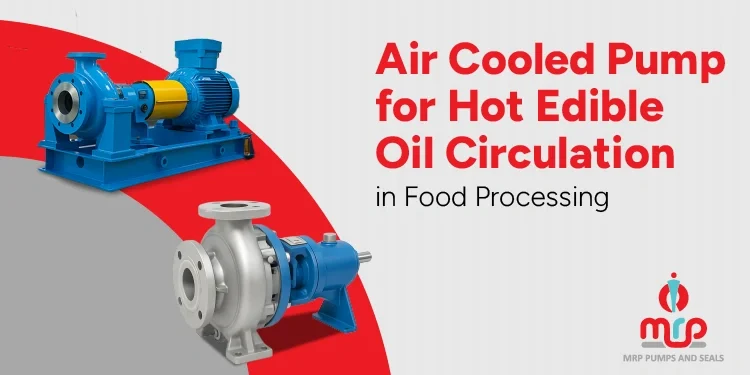
An air-cooled pump is a centrifugal pump with a built-in cooling system. It uses air instead of water to cool the bearings and mechanical seals. The pump features an auxiliary impeller on the rotor assembly that circulates process fluid through an air-cooled heat exchanger.
This design removes the need for an external water supply, a major advantage where clean water is limited. It also removes the risk of water contamination entering the oil circuit.
At MRP Pumps, our Air Cooled Pumps are built with canned motor technology and feature optional bearing wear monitors for predictive maintenance.
Why Is an Air-Cooled Pump Essential for Hot Edible Oil Circulation?
Hot edible oil circulation is critical in snack production and oil refining. These operations run oil continuously at extreme heats. Standard pumps struggle as high temperatures degrade conventional seals fast.
- Air-cooled pumps are the first choice because:
- Lower Infrastructure Costs: The self-cooling design cuts out water piping.
- Leak-Free Operation: Heavy-duty seals prevent dangerous oil spills.
- Continuous Duty: Built for 24/7 operation in demanding food plants.
- Food Safety: Contamination-free oil transfer supports FSSAI requirements.
How Does an Air-Cooled Pump Work in Food Processing?
The working principle is straightforward. Let’s break it down step by step.
Step 1 Suction:
The pump draws hot edible oil from the fryer, storage tank, or processing vessel through the suction port.
Step 2 Impeller action:
A closed impeller accelerates the oil. This converts motor energy into fluid velocity.
Step 3 Discharge:
The volute casing converts velocity into pressure. Oil flows to the next stage – fryer, heat exchanger, or storage.
Step 4 Self-cooling:
An auxiliary impeller at the rear circulates a small amount of fluid through the air-cooled heat exchanger. This keeps the bearing housing and seal area well below critical temperature limits.
The entire process runs without any external cooling water. This is what makes air cooled pumps uniquely suited for hot oil applications in the food industry.
What Are the Applications for Food Processing?
Air cooled pumps serve multiple hot oil applications across the food sector. Here are the most common ones:
- Namkeen and snack frying plants – Continuous hot oil circulation through fryer machines at 180°C–220°C.
- Bakery and confectionery units – Heated oil transfer for baking ovens and coating systems.
- Edible oil refining – Oil circulation during deodorization, bleaching, and refining stages.
- Instant noodle manufacturing – frying oil circulation at controlled temperatures.
- Packaged food production – Hot oil transfer in heat exchanger systems for cooking and pasteurization.
How to Select the Right Air-Cooled Pump for Edible Oil?
Selecting the wrong pump leads to frequent breakdowns and contamination risk. Follow this checklist to choose correctly.
Parameter | What to Check | Typical Range for Edible Oil |
Flow rate | Match to your system’s circulation requirement | 5–450 m³/hr |
Head (pressure) | Calculate total system resistance | Up to 80–150 meters |
Temperature | Maximum oil temperature in operation | 150°C–350°C |
Viscosity | Edible oil viscosity changes with temperature | 2–50 cSt (at operating temp) |
Material of construction | Must resist corrosion and heat | Cast iron, SS 410, alloy steel |
Seal type | Mechanical seal rated for high temperature | Carbon/SiC or TC/TC faces |
Motor rating | Match to hydraulic power requirement | 1.5 HP–100 HP |
Pro tip from our engineers: Always select a pump rated 10%–15% above your maximum operating temperature. This provides a safety margin against temperature spikes during startups.
What Materials Are Best for Food-Grade Hot Oil Pumps?
Material selection directly impacts pump life and food safety. Here’s what works best:
- Pump casing and impeller: Cast iron (IS 210 Grade FG 260) is standard for most edible oil applications. For higher corrosion resistance, SS 304 or SS 316 are preferred.
- Shaft: EN8 or SS 410 steel. Must resist thermal fatigue and bending stress.
- Mechanical seals: Carbon vs. Silicon Carbide faces. Must handle high temperatures without dry running damage.
- O-rings and gaskets: Viton or PTFE-based materials. Standard rubber degrades rapidly above 150°C.
At MRP Pumps, we offer multiple material options – from cast iron to Hastelloy – depending on the fluid, temperature, and food safety requirements.
What Safety Standards Apply to Pumps in Food Processing?
Food processing pumps must comply with several safety and quality standards. Here are the key ones:
- FSSAI Compliance: Must support hygienic handling and food-grade materials.
- ISO 2858: Governs dimensions for interchangeability. MRP Pumps designs with back pull-out construction, allowing maintenance without disturbing piping.
- ATEX / IS 5571 (if applicable): For plants handling flammable oils, pumps may need explosion-proof motor certification.
- GMP / GHP compliance: FSSAI mandates Good Manufacturing Practices and Good Hygiene Practices. Pumps should be easy to clean, inspect, and maintain without contamination risk.
Maintenance Checklist for Air Cooled Pumps in Food Plants
Regular maintenance extends pump life and prevents unplanned downtime. Follow this practical checklist:
- Daily: Check for oil leaks around the seal area. Listen for unusual vibration or noise.
- Weekly: Inspect the air-cooled heat exchanger fins. Clean dust or debris buildup.
- Monthly: Check bearing temperature with an infrared thermometer. Compare against baseline readings.
- Quarterly: Inspect mechanical seal faces for wear. Replace if scoring or leakage is detected.
- Six months: Check shaft alignment. Misalignment accelerates seal and bearing failure.
- Annually: Full pump inspection – impeller, casing wear rings, shaft sleeve, and bearings.
What Other Pumps Support Food Processing Operations?
While air cooled pumps handle hot oil circulation, food plants often need additional pump types for other processes:
- Centrifugal Process Pumps – General-purpose fluid transfer and circulation.
- Multi-Purpose Rotary Gear Pumps – Viscous oil transfer at lower temperatures.
- Progressive Cavity Screw Pumps – Handling thick sauces, pastes, or oils with suspended particles.
- Metering Dosing System Plunger & Diaphragm Pumps – Precise additive dosing in oil refining.
- Close Coupled Centrifugal Pumps – Compact units for water supply and CIP (Clean-in-Place) systems.
- Centrifugal Monoblock Pumps – Integrated motor pump units for general utility applications.
As an Industrial Process Pumps & Seals Manufacturer in Ahmedabad, MRP Pumps supplies the complete range of pumps for food processing – from hot oil circulation to water treatment and chemical dosing.
Why Choose MRP Pumps for Your Food Processing Plant?
MRP Pumps brings 15+ years of industrial pump expertise. We serve food processing, chemical, petrochemical, pharmaceutical, textiles, and many other industries across India.
Here’s what sets us apart:
- Custom pump solutions tailored to your exact flow, pressure, and temperature needs.
- Back pull-out design for easy maintenance without disturbing piping.
- ISO 2858-dimensional compliance for hassle-free installation and replacement.
- Full range of materials cast iron, stainless steel, alloy steel, and specialty alloys.
- End-to-end support from selection and sizing to installation, maintenance, and spare parts.
Conclusion
Air cooled pumps are the best choice for hot edible oil circulation in food processing. They eliminate water cooling, reduce contamination risk, and deliver reliable performance at high temperatures.
Choosing the right pump means matching flow rate, pressure, temperature, and material to your exact process. It also means working with a manufacturer who understands food industry requirements.
MRP Pumps – a trusted Industrial Process Pumps & Seals Manufacturer in Ahmedabad — designs and supplies air cooled pumps built for the demands of modern food processing.
Contact MRP Pumps today to find the right solution for your plant.
Frequently Asked Questions (FAQs)
1. What is an air-cooled pump used for food processing?
It circulates hot edible oil in fryers, refineries, and bakery systems. The built-in cooling system handles oil temperatures up to 250°C–350°C without external water.
2. Why is an air-cooled pump better than a water-cooled pump for edible oil?
It eliminates water contamination risk, requires less infrastructure, and costs less to maintain. For food-grade applications, this makes it a safer and more practical choice.
3. What temperature can an air-cooled pump handle?
Most air-cooled pumps for food processing handle temperatures between 150°C and 350°C, depending on the model and material of construction.
4. What materials should a food-grade hot oil pump use?
Cast iron or stainless steel (SS 304/316) for the casing and impeller. Viton or PTFE for seals and gaskets. The specific choice depends on the oil type and operating temperature.
5. How often should I maintain an air-cooled pump?
Daily visual checks, weekly fin cleaning, monthly bearing temperature monitoring, and quarterly seal inspection. A full overhaul should happen annually.
6. Does MRP Pumps manufacture air cooled pumps for food processing?
Yes. MRP Pumps is an Industrial Process Pumps & Seals Manufacturer in Ahmedabad. We design air-cooled pumps specifically for high-temperature food and industrial applications.
7. Can the same pump be used for thermic fluid and edible oil?
Yes, air-cooled pumps handle both thermic fluids and edible oils. However, material selection may differ based on fluid properties. Consult our team for the right specification.
8. What is the advantage of back pull-out design in food plants?
It allows complete removal of the rotating assembly without disconnecting piping. This makes maintenance faster and cleaner – essential for food plant hygiene standards.