


Key Takeaways
- Proper pump sizing cuts energy costs by 15-30% and extends seal life to 40+ months, delivering ROI in 18-24 months.
- Seal failures cause 60% of pump breakdowns—prevented through correct material selection and precision installation.
- Hot oil thermal transfer pumps handle 350°C+ temperatures, and corrosion-resistant designs last 200-300% longer in saltwater injection.
- Right-sizing, premium seals, and VFDs reduce downtime by 80-90% in refinery operations.
Introduction
The oil and gas industry depends on reliable fluid handling at a large scale. From moving crude oil through pipelines to managing thermal fluids in refineries, centrifugal pumps are the backbone of operations. But with dozens of pump types available, how do you know which centrifugal pump will handle your specific application?
At MRP Pumps and Seals, we have engineered solutions for refineries, petrochemical plants, and oil extraction facilities across India. This guide explores the critical applications of centrifugal pumps in oil & gas, why they are essential, and how to select the right pump for your operation.
What are Centrifugal Pumps?
- These are the most widely used industrial pumps, specifically designed to move low-viscosity fluids such as water, solvents, and thin chemicals.
- They operate by using a rotating impeller to create a vacuum, drawing fluid in and accelerating it outward using centrifugal force. This process converts kinetic energy (speed) into hydrodynamic pressure.
- Best suited for scenarios requiring high flow rates where fluid thickness (viscosity) is minimal.
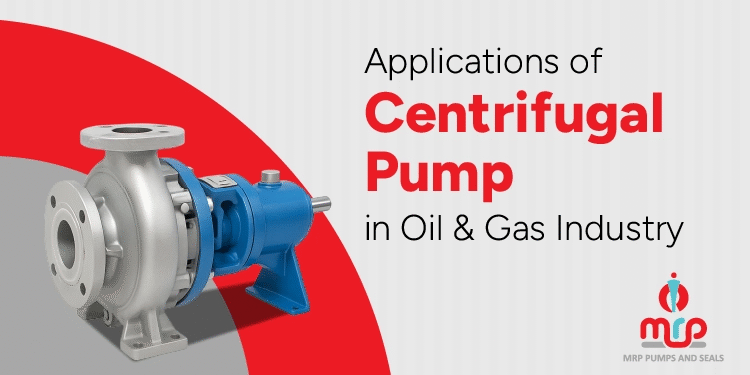
- At MRP Pumps, our flagship Centrifugal Process Pumps (MRP-CP) are engineered to conform to ISO 2858 dimensional standards.
- This adherence to standards ensures full dimensional interchangeability and operational efficiency for critical sectors like water treatment and chemical processing.
What Makes Centrifugal Pumps the Preferred Choice for Oil & Gas Refineries?
Centrifugal pumps dominate the oil and gas sector because they are built for high-volume and continuous operation. Unlike positive displacement pumps, centrifugal pumps use rotating impellers to accelerate fluid outward, generating pressure and flow.
Here’s why these matters: Oil refineries process thousands of barrels daily. Equipment must be reliable, efficient, and cost-effective over years of operation. Centrifugal pumps deliver on all three fronts.
They handle viscous liquids, abrasive slurries, corrosive chemicals, and hot thermal fluids without constant maintenance. They also scale whether you need 50 gallons per minute (GPM) or 5,000 GPM. A properly designed centrifugal pump system moves fluid reliably.
A petrochemical plant using undersized pumps wastes energy and risks production shutdowns. Correctly sized centrifugal pumps reduce operational costs by 15-30% while improving system stability.
What Are the Key Applications in Oil & Gas Operations?
1. Crude Oil Transfer and Pipeline Transport
Crude oil extraction doesn’t end at the wellhead. Oil must move from storage tanks to refinery units, sometimes across long distances. Centrifugal pumps excel at this task because they maintain steady flow rates even with viscous, heavier crude grades.
For viscous oils, horizontal single-stage suction pumps provide the low-pressure, high-flow characteristics needed. Modern designs include wear-resistant impellers that extend service life in abrasive environments.
2. Thermal Fluid Circulation in Refineries
Refineries use heat exchangers to crack hydrocarbons into lighter fractions. Thermal fluids circulate through heating coils at temperatures reaching 350°C or higher. Standard pumps fail under these conditions.
Hot oil thermal transfer pumps solve this problem. MRP Pumps’ thermal transfer designs maintain performance at extreme temperatures while preventing fluid degradation. The pump’s mechanical seal and bearing assembly stay cool through integral air cooling or jacket cooling—critical for long equipment life.
3. Chemical Injection and Additive Dosing
Oil pipelines use corrosion inhibitors, anti-foaming agents, and flow improvers. These chemicals must be injected precisely at different points. Metering plunger pumps and positive displacement pumps handle this, though high-pressure applications also use high-pressure multistage centrifugal pumps when precise metering combines with larger volumes.
4. Slurry and Mud Handling in Drilling Operations
Drilling generates drill cuttings—a mixture of rock, fluid, and clay. This abrasive slurry must be moved to separation equipment. Slurry pumps with elastomer-lined casings resist wearing hard particles. Some operations also use centrifugal end suction pumps with reinforced internals for similar duty.
5. Seawater and Saltwater Injection for Pressure Maintenance
Enhanced oil recovery (EOR) requires injecting saltwater into reservoirs to maintain pressure. These corrosive, high-volume applications demand polypropylene corrosion-resistant centrifugal pumps or stainless-steel designs that prevent rust and extend bearing life.
6. Cooling Tower and Circulation Water Systems
Refineries need massive cooling capacity. Centrifugal pumps circulate cooling water through condensers and air coolers. High-flow, low-head pumps are ideal here—they prioritize volume over pressure, maximizing efficiency while minimizing energy consumption.
7. Vacuum Distillation Tower Operations
Vacuum distillation separates heavy crude residues. These processes require liquid ring vacuum pumps to maintain absolute pressure in distillation columns. Two-stage liquid ring vacuum pumps handle higher vacuum levels needed for premium product separation.
Which Centrifugal Pump Type Should You Choose?
The right pump depends on your duty conditions: flow rate, head requirement, fluid properties, temperature, and corrosiveness.
1. For standard crude oil and refinery operations: Horizontal single-stage centrifugal pumps are economical and reliable. They’re close-coupled for compact installations or flexible-coupled for applications requiring vibration isolation.
2. For hot thermal fluids: Thermal transfer pumps with integral cooling systems maintain seal integrity and prevent fluid breakdown at elevated temperatures.
3. For high-pressure applications: Multistage centrifugal pumps generate higher discharge pressure by stacking multiple impeller stages. This is common for boiler feedwater, high-pressure injection systems, and tertiary recovery operations.
4. For corrosive or slurry-laden fluids: Polypropylene or elastomer-lined pumps resist chemical attack and abrasive wear, extending service intervals between maintenance.
5. For variable or low-flow applications: Positive displacement pumps like progressive cavity screw pumps or metering plunger pumps provide precise flow control when centrifugal pumps would be oversized.
Centrifugal Pump Sizing: A Step-by-Step Guide for Oil & Gas
Under-sizing leaves you short on capacity; oversizing wastes energy and money. Follow this process:
Step 1: Calculate the required flow review process design specifications. If pumping crude oil through a pipeline, know the pipeline diameter and desired velocity. A typical rule: 4-6 feet per second prevents erosion while minimizing friction losses.
Step 2: Determine Total Dynamic Head (TDH) TDH = static head (elevation difference) + friction losses in pipes + pressure differential across equipment. For a refinery transferring oil 50 meters uphill through 500 meters of pipe, friction losses alone might add 20-30 meters of head.
Step 3: Apply a Safety Factor. Select a pump rated 10-15% above calculated requirements. This accounts for fluid property variations, wear, and system changes over time.
Step 4: Consider Fluid Properties. Higher viscosity increases friction losses. Abrasive slurries require wear-resistant materials. Hot fluids require seals rated for elevated temperatures.
What About Pump Efficiency and Energy Costs?
A centrifugal pump’s efficiency is its brake horsepower (BHP) divided by hydraulic horsepower. Most industrial pumps operate at 75-88% efficiency at their best efficiency point (BEP).
The hidden cost: Operating a pump 30% away from BEP reduces efficiency by 10-15%, consuming 8-12% more power. Over a year, this adds thousands of electricity bills.
Modern pump selection software (affinity laws) helps predict performance at different speeds and flow rates. Variable frequency drives (VFDs) on pump motors allow speed adjustment to match demand—dropping energy consumption significantly when full flow isn’t needed.
For MRP Pumps customers: Our multistage and high-flow designs incorporate hydro-dynamically optimized impellers that maintain high efficiency across a wider operating range. This means better performance during seasonal flow variations common in oil and gas operations.
Common Challenges and Solutions
1. Cavitation and Noise
Problem: Inlet pressure drops below fluid vapor pressure, creating bubbles. Bubbles collapse violently, eroding impeller surfaces and causing noise.
Solution: Ensure positive head at pump inlet. Install suction strainers to prevent debris from blockage. Use vertical sump pumps or vertical inline centrifugal pumps for low-pressure suction applications where cavitation risk is highest.
2. Mechanical Seal Failures
Problem: Seals fail prematurely in hot, corrosive oil & gas environments, causing fluid loss and downtime.
Solution: Upgrade to dual mechanical seals with pressurized buffer fluid (plan 53 system). Use compatible seal materials—carbon-silicon carbide for corrosive duty, tungsten carbide for abrasive slurries. MRP Pumps supplies premium seal assemblies engineered for 3,000+ hour life in demanding applications.
3. Alignment and Vibration
Problem: Misaligned couplings cause bearing wear, seal damage, and noise.
Solution: Use precision laser alignment during installation. For sensitive applications, employ flexible couplings that tolerate minor misalignment while dampening vibration.
4. Corrosion in Saltwater Systems
Problem: Seawater injection corrodes mild steel casings and internals rapidly.
Solution: Specify polypropylene or stainless-steel centrifugal pumps. These materials resist chloride attacks. Also upgrade to duplex stainless bolts and hardware.
Centrifugal Pump Types for Oil & Gas
|
Pump Type |
Best For |
Pressure Range |
Flow Range |
Temperature Limit |
Key Advantage |
|
Single-Stage Horizontal |
Crude transfer, cooling water |
10-30 bar |
100-5,000 GPM |
80°C |
Cost-effective, reliable |
|
Thermal Transfer |
Hot oil circulation |
10-25 bar |
50-2,000 GPM |
350°C+ |
Handles extreme temperatures |
|
Multistage |
High-pressure injection, boiler feed |
30-250 bar |
50-1,000 GPM |
120°C |
Compact, high pressure |
|
Slurry/Mud Pump |
Drilling solids, abrasive fluids |
10-35 bar |
200-3,000 GPM |
60°C |
Erosion-resistant internals |
|
Polypropylene/SS |
Saltwater injection, corrosive chemicals |
15-40 bar |
100-1,500 GPM |
60°C |
Corrosion-resistant |
|
Liquid Ring Vacuum |
Vacuum distillation |
Vacuum (0.01-0.5 bar) |
50-1,000 GPM |
80°C |
Handles vapors, self-priming |
How to Get Started: Your Action Plan
1. Audit Your Current Pumping Systems Document flow rates, head requirements, fluid properties, temperatures, and maintenance history. Identify underperforming or frequently failing units.
2. Consult with Experts Don’t guess. Work with pump specialists who understand refinery processes, duty cycles, and failure modes specific to oil & gas.
3. Consider Total Cost of Ownership Factor in purchase price, installation, energy consumption, maintenance intervals, and downtime risk. A 20% more expensive pump that runs longer and uses less energy wins over time.
4. Specify Premium Seals and Materials In oil & gas, seal failures and corrosion are expensive. Premium materials (stainless steel, polypropylene, tungsten carbide seals) extend service life and reduce unexpected shutdowns.
Conclusion: MRP Pumps and Seals for Your Oil & Gas Operations
The oil and gas industry can’t afford equipment failures. At MRP Pumps and Seals, we have engineered centrifugal pump solutions for refineries, petrochemical plants, and drilling operations across India for over two decades. Whether you need a hot oil thermal transfer pump for high-temperature circulation, a multistage pump for injection duty, or a corrosion-resistant polypropylene pump for saltwater systems, our expertise ensures reliable operation.
We understand the specific pressures, temperatures, and fluid properties of oil and gas work. Our pumps come backed by premium sealing solutions, efficient impeller designs, and engineering support to optimize your system’s total cost of ownership.
Every refinery, petrochemical plant, and drilling operation has unique pumping challenges.” Schedule a consultation Our pump engineers review your current system and identify efficiency gains worth thousands annually.
Frequently Asked Questions (FAQs)
1. What’s the difference between centrifugal and positive displacement pumps?
Centrifugal pumps handle high volumes at variable pressures (ideal for crude transfer & cooling); positive displacement pumps handle precise metering, high viscosity, and lower volumes. Most refineries use both.
2. How often should seals be replaced?
Standard duty: 18-40 months; hot oil (300°C+): 12-18 months; corrosive/slurry: 12-24 months. Key factors: temperature, fluid cleanliness, alignment, and seal material.
3. Can centrifugal pumps handle crude oil with varying viscosity?
Yes, for fluids under 100 cSt. Standard crude (20-80 cSt) works well; heavy crude (80-200 cSt) requires larger impellers; very heavy oil benefits from positive displacement pumps.
4. What’s the most common failure mode?
Seal failures cause 60% of breakdowns. Prevention: correct seal materials, cooling systems, precision alignment, clean fluid, and dual seals for critical applications.
5. How to reduce energy consumption?
Right-size pumps, install VFDs (save 20-40% energy), use optimized impellers, maintain alignment, and conduct regular maintenance—payback within 18-24 months.
6. What materials are for saltwater injection (EOR)?
Specify polypropylene or duplex stainless steel (ASTM 2205) for casing; upgrade fasteners to duplex stainless; use tungsten carbide seals; implement flushing protocols.
7. How do pump selection and VFDs improve reliability?
Correct sizing prevents failures; VFDs optimize efficiency across variable demand, reducing energy 20-40% and extending seal/bearing life—typical payback: 18-24 months.